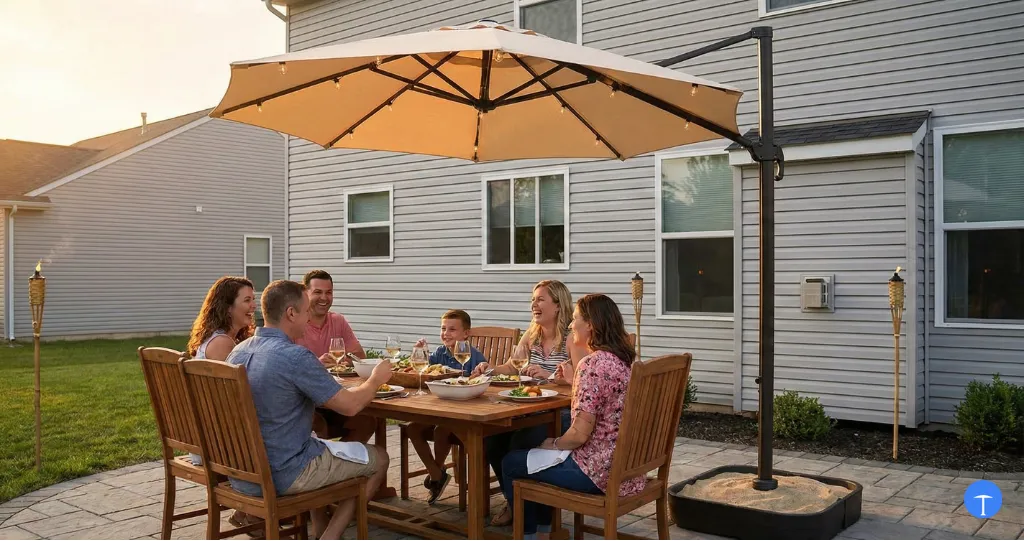
An offset umbrella is a patio umbrella with its support pole positioned to the side of the canopy rather than running straight through the center. Sometimes called a cantilever umbrella, this freestanding patio umbrella suspends its shade overhead without anything blocking the space underneath, so your table, chairs, and loungers sit completely in the clear. Retailers use both “offset” and “cantilever” for the same product, but throughout this guide we will stick with “offset” since that is how most people search for them.
If you have ever tried to fit a traditional umbrella over a dining set that does not have an umbrella hole, or wanted unobstructed shade over a pool lounge area, the offset design solves exactly those problems.
The core difference comes down to where the pole sits. A traditional umbrella plants its pole in the center of the canopy, which works when your table has an umbrella hole but limits placement options.
An offset patio umbrella flips this arrangement. The vertical pole stands off to one side, and a horizontal arm extends outward to hold the canopy above whatever you need shaded.
This side pole umbrella approach keeps your entire shaded area open. No center post cutting through your dining table, no pole to navigate around, and no requirement for furniture with an umbrella hole.
The tradeoff is that the offset umbrella design needs a heavier base to counterbalance the canopy hanging out to one side. A center pole umbrella distributes weight evenly, but an offset model fights gravity and leverage at the same time. That means the offset umbrella base typically carries 150 to 250 or more pounds of counterweight depending on canopy size. We cover specifics in the best base for offset umbrella guide.
Understanding how an offset umbrella works starts with the basic mechanics. A heavy base sits on the ground, filled with sand, water, or weighted with concrete plates. A vertical mast rises from that base, and near the top a horizontal arm extends outward at roughly a 90 degree angle. The canopy attaches at the end of that arm.
Most offset umbrellas open and close using a crank handle on the vertical mast. Some higher end models use a foot pedal at the base instead. Beyond the opening mechanism, the standout offset umbrella features are rotation and tilt.
Offset umbrella rotation is one of the biggest advantages of this design. Many models rotate a full 360 degrees around the mast, so you can swing the shade to follow the sun throughout the day without moving the base.
The offset umbrella tilt system adds another layer of adjustability. Most models let you angle the canopy at multiple positions, which is especially useful during morning and late afternoon when the sun comes in low. Between rotation and tilt, you can track shade across almost any angle throughout the day.
Every offset umbrella shares the same core anatomy. Knowing what each part does helps when you are comparing models side by side or troubleshooting an issue down the road.
| Component | What It Does | What to Look For |
|---|---|---|
| Base/Weight System | Anchors the umbrella and counterbalances the offset canopy | Cross base with weight plates or weighted plate base; 150 to 250+ lbs total depending on canopy size |
| Vertical Mast | Main upright pole that supports the entire structure | Aluminum for lightweight durability; steel on budget models; powder coated finish for weather protection |
| Horizontal Arm | Extends from the top of the mast outward to hold the canopy | Smooth pivot mechanism; reinforced joint where it meets the mast |
| Hub/Joint | Connects the arm to the mast and enables tilt and rotation | Ball joint or multi position locking system; metal construction over plastic |
| Ribs | Skeleton structure that gives the canopy its shape and tension | 6 to 8 ribs on most models; aluminum or fiberglass for flexibility and wind resistance |
| Canopy | Fabric panel that provides the actual shade coverage | Polyester for budget, olefin for mid range, Sunbrella for premium UV protection and colorfastness |
| Crank or Pedal Mechanism | Opens, closes, and adjusts the canopy position | Metal gears over plastic; smooth operation without binding; easy to reach from a standing position |
| Tilt System | Angles the canopy to block low sun from different directions | Multiple locking positions; easy one hand adjustment is preferred |
Offset umbrellas come in a range of sizes, and the right one depends on how much ground you need to cover. Here is a quick look at the most popular options and the offset umbrella canopy shape choices available at each size.
| Canopy Size | Canopy Shape Options | Approximate Shade Coverage (sq ft) | Best For |
|---|---|---|---|
| 9 ft | Round, octagonal | 60 to 65 | Small bistro sets, two person dining areas, compact patios |
| 10 ft | Round, square, octagonal | 75 to 80 | Standard four person dining tables, small lounge setups |
| 11 ft | Round, octagonal, rectangular | 95 to 100 | Six person dining sets, larger seating groups, poolside coverage |
| 13 ft | Round, octagonal, rectangular | 130 to 135 | Full outdoor living areas, large dining groups, hot tub surrounds, commercial spaces |
Round and octagonal canopies are the most common shapes you will find. Square and rectangular options provide better edge to edge coverage over angular furniture like rectangular dining tables. If you need help matching a canopy size to your specific table or seating layout, the patio umbrella size chart walks through the measurements.
Frame materials matter at every size. Aluminum is the standard because it resists rust and stays lightweight enough to manage across seasons. Steel frames show up on budget models but are heavier and more corrosion prone if the coating chips. For canopy fabric, polyester covers entry level, olefin provides better fade resistance at a moderate price, and Sunbrella sits at the premium end with superior UV protection and colorfastness.
The offset design really earns its keep in specific situations where a center pole umbrella would be awkward, impractical, or simply not an option.
Poolside is one of the top spots for an offset umbrella. Position the base behind a row of lounge chairs and swing the hanging patio umbrella canopy directly overhead. Nobody deals with a pole between their chair and the pool, and 360 degree rotation makes it easy to track shade as the sun moves.
If your patio table does not have an umbrella hole, a center post umbrella is not going to work. An offset model solves this cleanly. Set the base to one side and extend the canopy overhead. Your dining area stays completely open with full shade coverage during meals.
Hot tubs rarely have a convenient spot for a center pole umbrella. An offset design lets you position the base on the deck or patio beside the tub and float shade directly overhead, reducing UV exposure during peak hours while you soak. Adjusting the tilt angle also adds some privacy screening depending on your setup.
When you are shading a big sectional sofa or an L shaped seating group, one center pole umbrella usually cannot cover the whole area. A large offset umbrella in the 11 ft or 13 ft range can shade the entire group from a single base position, and rotation plus tilt let you adjust as people shift around.
Offset umbrellas are not the right fit for every situation, and it is worth knowing the limitations before you commit.
Very small patios and balconies are a tough match. The base system alone takes up significant floor space, and the horizontal arm needs clearance to swing. If you are working with a compact area, a traditional market umbrella that fits through a table hole will serve you better and leave more usable space.
Extremely windy and exposed locations present challenges for offset umbrella wind resistance. The canopy acts like a sail on the extended arm, catching significantly more force than a center pole design. Proper anchoring and a heavy base help, but most manufacturers recommend closing offset umbrellas when sustained winds exceed 20 to 25 mph.
Frequent relocation is another weak point. Once you load 150 to 250 pounds of counterweight onto the base, moving the umbrella is not casual. Some bases come with wheels, but you are still maneuvering a heavy setup. If you need portable shade, a lighter center pole option is more practical. Before you buy, figure out what base size you need so the system stays stable.
Yes, both names describe the same product. Offset and cantilever both refer to a patio umbrella with the support pole positioned to the side rather than through the center of the canopy. Retailers use the terms interchangeably, though “cantilever” tends to appear more in specialty outdoor furniture stores. The full offset vs cantilever umbrella comparison explains the naming in more detail.
Most offset umbrella bases weigh between 150 and 250 pounds when fully loaded. A 9 ft model might need around 150 pounds of counterweight, while a 13 ft canopy typically requires 200 pounds or more. Cross bases with individual weight plates are the most common style and let you build up to the right weight gradually.
Absolutely. That is one of the main advantages of the offset design. You position the base beside or behind the table, and the canopy extends overhead to shade the entire dining surface. There is no need for an umbrella hole in the table, and the pole stays completely out of the seating area.
Most offset umbrellas rotate a full 360 degrees around the vertical mast, letting you follow the sun throughout the day without repositioning the heavy base. Some budget models offer limited rotation in a smaller arc, so check the specifications before purchasing if full rotation matters to your setup.
The 10 ft and 11 ft canopy sizes are the most popular for residential use. A 10 ft offset umbrella covers a standard four person dining table comfortably, while an 11 ft model gives you extra reach for larger seating groups. The 13 ft size is gaining popularity among homeowners who want to shade full outdoor living areas.
If you need overhead shade without a center pole getting in the way, an offset umbrella is likely your best option. The design excels for poolside setups, dining areas without umbrella holes, hot tub surrounds, and any large seating arrangement where coverage and adjustability matter.
The key tradeoffs are a heavier base, a higher price point, and less portability. If those tradeoffs make sense for your space, an offset umbrella delivers shade coverage and flexibility that traditional designs cannot match.
Consider whether an offset umbrella is worth the investment for your situation, then browse the best offset umbrellas to see top rated models across every size and price range.