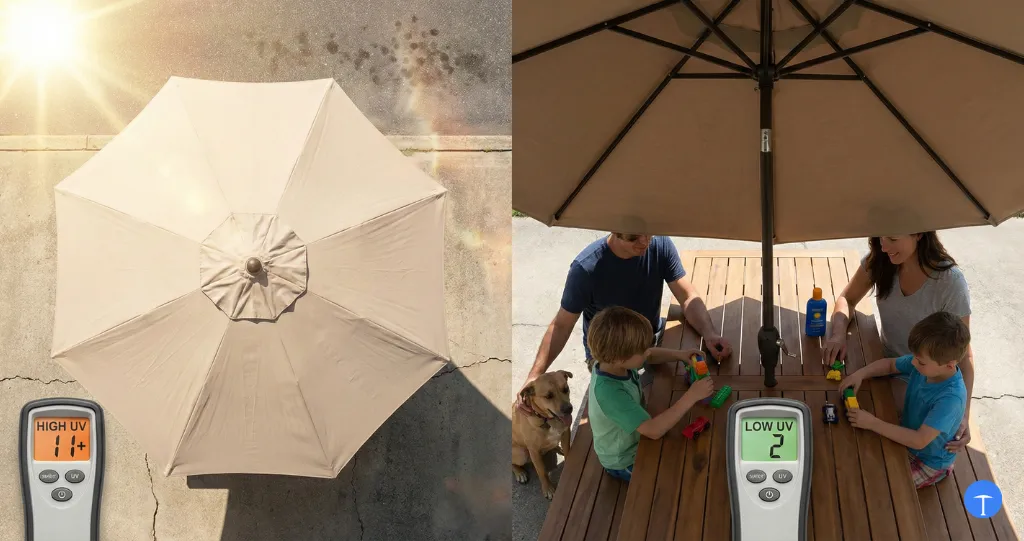
Yes, patio umbrellas do block UV rays, but the level of protection varies dramatically depending on the fabric, UPF rating, color, and construction of your umbrella. A premium canopy made from solution-dyed acrylic can block up to 99% of UV radiation, while a budget nylon umbrella might only stop 80%. Understanding the difference is the key to actually staying protected outdoors.
Most people assume that sitting under any patio umbrella means they’re safe from the sun. That assumption leads to sunburns at backyard BBQs and long afternoons on the patio that leave your skin redder than expected. Whether your outdoor umbrella can actually protect from sun exposure depends on what it’s made of, and that distinction matters more than most people realize.
Patio umbrellas block anywhere from 75% to over 99% of UV radiation depending on what they’re made of. A standard polyester canopy without UV treatment blocks roughly 93% to 97% of UV rays. Upgrade to a solution-dyed acrylic fabric like Sunbrella and you’re looking at 98% to 99% protection with a verified UPF 50+ rating.
The difference sounds small until you do the math. A fabric blocking 93% lets through 7% of rays. A UPF 50+ fabric lets through less than 2%. That means the cheaper fabric allows more than three times as much UV to reach your skin, and over a full afternoon outdoors, that gap adds up fast. The difference between a basic sun umbrella vs a regular umbrella with no UV treatment is the difference between real protection and a false sense of security.
Both types of ultraviolet radiation reach your skin outdoors, and a quality patio umbrella needs to block both. UVB rays cause sunburn and affect the outer layer of your skin, strongest between 10 AM and 4 PM. UVA rays penetrate deeper, causing premature aging, wrinkles, and long-term cellular damage. UVA is present all day, even on overcast days, and passes through clouds and glass.
Both contribute to skin cancer risk, which is why dermatologists stress full-spectrum UV protection. Cheaper umbrella fabrics tend to let UVA through more easily because those longer-wavelength rays are harder to stop. When evaluating an umbrella for sun protection, look for canopy materials tested against the full UV spectrum, not just UVB.
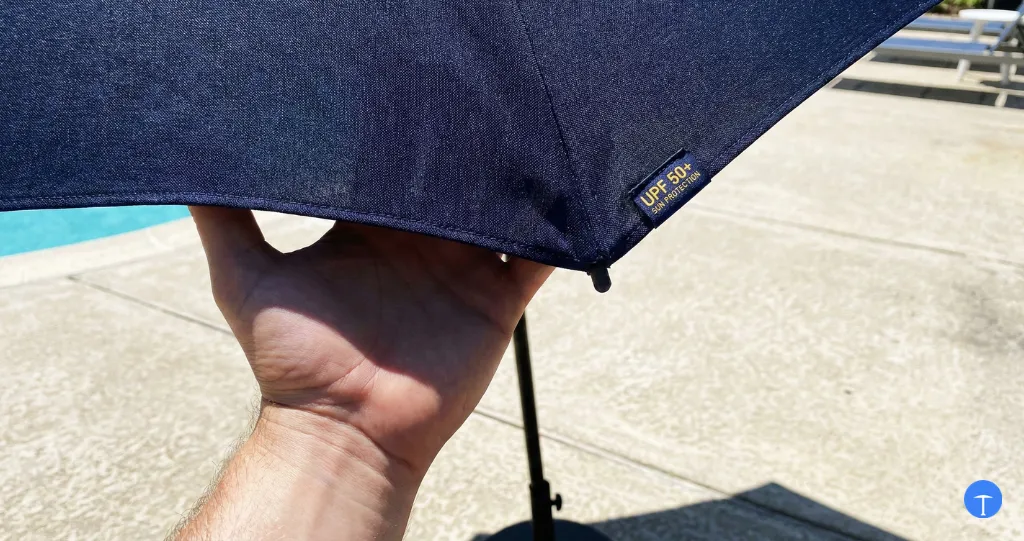
UPF stands for Ultraviolet Protection Factor, and it’s the fabric equivalent of SPF for sunscreen. A patio umbrella with a UPF 50 rating allows only 1/50th of UV rays to pass through the canopy, blocking 98% of UV radiation. Unlike SPF, which only measures UVB, UPF measures protection against both UVA and UVB. Here’s how the rating scale breaks down:
| UPF Rating | Protection Category | UV Rays Blocked | UV Transmission | Recommended For |
|---|---|---|---|---|
| UPF 15-20 | Good | 93.3-95.9% | 6.7-4.1% | Light, occasional sun exposure |
| UPF 25-35 | Very Good | 96.0-97.4% | 4.0-2.6% | Regular outdoor dining and entertaining |
| UPF 40-50 | Excellent | 97.5-98.0% | 2.5-2.0% | Extended outdoor use and sun-sensitive skin |
| UPF 50+ | Maximum | 98.0%+ (up to 99.9%) | Less than 2.0% | All-day use, families with children, high UV climates |
One important caveat: a Drexel University study published in PMC found that many umbrella manufacturers claim UPF ratings without standardized testing to back them up. There’s no universal testing requirement for patio umbrellas the way there is for sun-protective clothing. That makes it critical to buy from reputable brands that provide third-party test results, like those certified by the Skin Cancer Foundation.
The canopy fabric is the single biggest factor in how much UV your patio umbrella blocks. Choosing the best fabric for UV protection in an umbrella is the most important decision you’ll make, and checking your patio umbrella UPF rating is the fastest way to compare options. The difference between a budget nylon canopy and a premium solution-dyed acrylic is not marginal. It’s the difference between meaningful UV exposure and genuine protection.
Weave tightness and density play a role beyond material type. A tightly woven fabric physically blocks more UV because there are fewer gaps for rays to pass through. UV coatings and silver or vinyl backings can boost mid-range fabrics, though these treatments degrade over time and may peel or crack after a few seasons.
| Fabric Type | Typical UPF Range | UV Blocked | Fade Resistance | Cost Level | Notes |
|---|---|---|---|---|---|
| Solution-Dyed Acrylic (Sunbrella) | UPF 50+ | 98-99% | Excellent | Premium | Skin Cancer Foundation certified, 10-year warranty typical |
| Olefin | UPF 50-80 | 98-99% | Excellent | Mid-Range | Eco-friendly, recyclable, naturally UV resistant |
| Solution-Dyed Polyester | UPF 30-50+ | 96-98% | Very Good | Mid-Range | Good balance of cost and protection |
| Standard Polyester | UPF 15-30 | 93-97% | Fair | Budget | Fades faster, UV protection decreases with age |
| Nylon | UPF 5-15 | 80-93% | Poor | Budget | Designed for rain, not sun protection |
| Coated Fabric (vinyl or silver backing) | UPF 50+ | 98-99% | Good | Varies | Coating can peel or crack over time |
Solution-dyed acrylic is the gold standard for patio umbrella UV protection. Brands like Sunbrella add color to the fiber before it’s woven, meaning the UV-blocking properties are built into the fabric itself. Sunbrella UV protection is backed by Skin Cancer Foundation certification, and these fabrics consistently test at UPF 50+ with warranties of 10 years or more against significant fading. The protection holds up because it’s part of the fiber structure, not a coating that wears off.
Olefin is naturally resistant to UV radiation without any coatings or treatments, consistently testing at UPF 50 or higher. It’s also recyclable and typically less expensive than Sunbrella while offering comparable UV-blocking performance, making it one of the best values in umbrella fabrics for sun protection.
There’s a meaningful gap between solution-dyed polyester and standard polyester. Solution-dyed versions typically land between UPF 30 and 50+ because the color is locked into the fibers during manufacturing. Standard polyester starts at a lower UPF range and loses its protective qualities faster as the fabric fades from sun exposure.
If you’re comparing Sunbrella vs regular fabric for UV protection, standard polyester is where you’ll see the biggest performance drop over time. A standard polyester canopy that tested at UPF 25 when new can fall below UPF 15 after two or three seasons.
Nylon was designed for water resistance, not sun protection. Most nylon canopies test between UPF 5 and 15, letting through 7% to 20% of UV rays. That might feel like shade, but your skin is still absorbing meaningful UV radiation underneath. If UV-blocking ability is a priority, nylon is the wrong choice for a patio umbrella canopy.
Color does affect how much UV your umbrella blocks, but the fabric type and UPF rating matter far more than whether you pick navy or beige.
Dark-colored canopies absorb more UV radiation than lighter ones. A black canopy, even without any special coating, can block 90% or more of UV rays because darker dyes absorb a broader range of light wavelengths. Navy blue, dark green, and burgundy all perform similarly well. The tradeoff is heat: dark canopies absorb more solar energy overall, making the air underneath noticeably warmer than under a light-colored umbrella.
White, cream, and pastel canopies reflect more visible light and heat, making the space underneath feel cooler. However, lighter colors transmit more UV radiation because the dyes absorb fewer wavelengths.
Color is secondary to fabric quality and construction. A white Sunbrella canopy rated UPF 50+ will block far more UV than a dark-colored nylon canopy with no UPF rating. The dye color makes a difference when comparing identical fabrics, but weave tightness, fiber density, and material composition have a much larger impact. Always check the UPF rating first when shopping for a UV-blocking umbrella.
Even with a UPF 50+ umbrella directly overhead, you’re not completely shielded from UV radiation. UV rays bounce off surrounding surfaces and reach you from angles your canopy doesn’t cover. Concrete reflects about 12% of UV radiation back up at you. Sand reflects 15% to 25%. Water can reflect up to 30%. If your patio has light-colored pavers or sits near a pool, indirect UV exposure is a real factor.
This is why dermatologists recommend wearing sunscreen even when you’re sitting in the shade. Your umbrella handles the direct overhead UV, but reflected rays hit you from below and from the sides.
A larger canopy creates a wider cone of shade that intercepts more reflected rays from oblique angles. That doesn’t change the UPF of the fabric, but it does reduce your total exposure. Choosing a properly sized umbrella for your seating area makes a measurable difference.
One question that comes up often is whether market umbrellas or cantilever umbrellas provide better UV protection. The answer is that the frame style doesn’t affect UV blocking at all. The protection comes entirely from the canopy fabric. A cantilever with Sunbrella fabric provides the same UPF as a center-pole market umbrella with the same canopy material. Choose your umbrella style based on your space and layout needs, not UV performance.
UV radiation gradually breaks down your umbrella’s fabric at the molecular level, reducing its ability to protect you. A canopy that tested at UPF 50 when new might drop to UPF 30 or lower after several seasons of constant exposure.
The rate of degradation depends on fabric type. Solution-dyed acrylics and olefin resist this breakdown far better than standard polyester or nylon because their UV-resistant properties are embedded in the fiber. Coated fabrics present a different issue: the vinyl or silver backing can peel, crack, or wear away, exposing the less-protective base fabric underneath.
Fabric density also decreases as fibers stretch and the weave loosens with age and weather exposure. This is one reason why the quality of your umbrella’s construction and components matters as much as the fabric choice itself.
Your umbrella won’t alert you when its UV protection drops, but there are visible warning signs.
Significant color fading is the most obvious indicator. If your once-vibrant canopy has turned pale and washed out, its UV-blocking capabilities have declined. Hold the canopy up to the sun and look from underneath. If you can see distinct pinpoints of light through the weave, the fabric has degraded enough that UV is passing through more than it should.
Feel the fabric between your fingers. If it’s noticeably thinner or more brittle than when you bought it, the fibers have broken down. Peeling or flaking on a coated canopy means the UV-protective layer is failing.
If you notice any combination of these signs, it’s time to replace the canopy or the umbrella.
All patio umbrellas block some UV, but the amount varies enormously. Not every umbrella will adequately protect you from sun damage. A premium solution-dyed acrylic canopy blocks 98% or more, while a budget nylon umbrella might only block 80%. Without a verified UPF rating from a reputable testing organization, you can’t know for certain how much protection you’re actually getting.
A patio umbrella with a high UPF rating significantly reduces your risk of sunburn from direct UV, but it won’t eliminate it entirely. UV reflects off surrounding surfaces like concrete, sand, and water, reaching your skin from angles the umbrella doesn’t cover. Dermatologists recommend combining umbrella shade with sunscreen for complete protection.
Look for UPF 50+ if you spend extended time outdoors or have sun-sensitive skin. UPF 25 to 35 is adequate for casual outdoor dining. Anything below UPF 15 provides minimal meaningful protection and shouldn’t be relied on as your primary UV defense.
Dark colors do absorb more UV radiation than light colors when the fabric type is identical. However, a light-colored umbrella made from a high UPF fabric like Sunbrella will outperform a dark-colored nylon umbrella by a wide margin. UPF rating matters far more than color choice.
Yes. Sunbrella fabric is rated UPF 50+, blocking 98% or more of UV radiation. It carries Skin Cancer Foundation certification and maintains its UV-protective properties for years because the protection is built into the fiber itself rather than applied as a coating that wears off.
For premium solution-dyed acrylic fabrics, UV protection can last 10 years or more with proper care. Standard polyester canopies may lose significant UV-blocking ability within two to three seasons. Coated fabrics depend on the integrity of the coating, which can begin to deteriorate within a few years of regular outdoor use.
Getting the most UV protection from your patio umbrella comes down to buying the right fabric, sizing it correctly, and maintaining it properly.
Start with a canopy rated UPF 50+ from a brand that provides third-party test verification. Solution-dyed acrylic fabrics like Sunbrella and olefin are the best options for long-lasting umbrella skin cancer protection. If budget is a concern, comparing costs across umbrella types can help you find the right balance.
Pair your umbrella with sunscreen for extended time outdoors, especially near reflective surfaces. Position it to maximize shade during peak UV hours between 10 AM and 4 PM, and tilt the canopy as the sun moves.
Clean the canopy regularly with mild soap and water to prevent buildup that accelerates fabric degradation. When not in use, close it and use a protective cover. Store it indoors during the off season. These maintenance steps extend the effective UV-blocking life of your canopy by several years.