Most patio umbrella problems look worse than they actually are. A broken rib, a snapped cord, a crank that won’t turn — these are all fixable with basic tools and an hour or less of your time. Knowing how to fix a patio umbrella saves you $100 to $400 in replacement costs, and the repairs themselves rarely run more than $10 to $30 in materials.
This guide covers every common patio umbrella repair, from diagnosing what went wrong to walking you through each fix step by step. You will also find a clear framework for deciding when a repair makes sense and when buying new is the smarter call.
Before pulling out any tools, take thirty seconds to assess overall condition. The quick version: if total repair costs would exceed half the price of buying a comparable new umbrella, replace it. Frame integrity is the deciding factor. If the main pole and hub are solid, almost everything else can be fixed or swapped. If the pole is cracked, severely bent, or corroded through, the foundation is compromised and no individual repair will make it reliable again.
Check your warranty before spending anything. Many mid-range and premium patio umbrellas carry one to three year warranties covering frame defects and hardware failures. A quick call to the manufacturer might get you free replacement parts. For the full cost breakdown and a detailed decision framework, see the Repair vs Replace section at the end of this guide.
To fix a patio umbrella, you first need to pinpoint what is actually broken. Use the table below to match what you are seeing with the most likely cause. Understanding the parts of a patio umbrella helps you identify exactly which component has failed.
| Symptom | Likely Cause | Difficulty | Section Link |
|---|---|---|---|
| Umbrella won’t open or close | Broken, tangled, or frayed cord; jammed crank | Moderate | Fixing the String/Cord |
| Umbrella sags or tilts to one side | Broken rib, bent pole | Easy to Moderate | Fixing Broken Ribs |
| Crank handle spins freely | Stripped crank gear, broken cord | Moderate | Fixing the Crank Mechanism |
| Canopy has holes or tears | Fabric damage from wind, UV, or debris | Easy | Fixing a Torn Canopy |
| Umbrella leans even when base is level | Loose tilt joint, bent pole, worn swivel | Easy to Moderate | Fixing a Wobbly Umbrella |
| Won’t stay in tilted position | Broken tilt mechanism, worn locking pin | Moderate | Fixing the Tilt Mechanism |
| Rust spots on frame or ribs | Moisture exposure, coating failure | Easy | Rust Removal and Prevention |
| Pole wobbles inside the base | Wrong size base, worn pole adapter | Easy | Fixing a Wobbly Umbrella |
| Collapses in light wind | Multiple broken ribs, worn hub | Hard (likely replace) | Repair vs Replace |
| Crank is stiff or grinding | Debris in housing, lack of lubrication | Easy | Fixing the Crank Mechanism |
If your umbrella has more than one symptom, note all the issues before you begin. Tackling multiple repairs in a single session is more efficient than discovering another problem during reassembly.
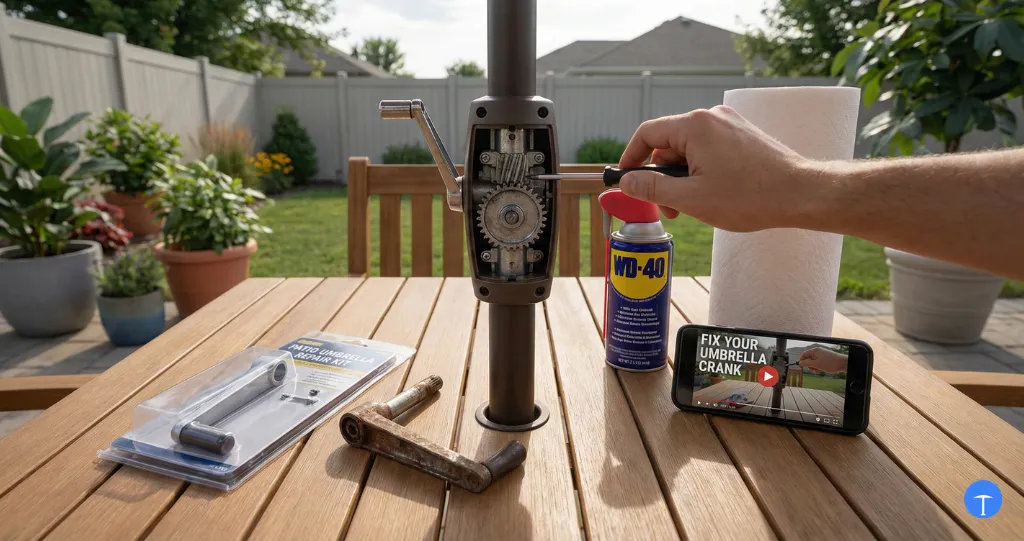
You probably own most of what you need already. The table below covers every tool and material referenced in this guide, so you can gather everything before you start.
| Tool/Material | Used For | Approximate Cost |
|---|---|---|
| Phillips and flathead screwdriver set | Crank housing, rib screws, general disassembly | $8–$15 |
| Pliers (needle nose and standard) | Cord routing, wire work, rib adjustment | $8–$12 |
| Drill with small bits (1/8 inch) | Rib splint holes, pole sleeve holes | $25–$40 (if you don’t own one) |
| 6 inch copper sleeve (5/8 inch) | Rib splint repair | $3–$5 |
| Small nuts, bolts, and washers (assorted) | Securing rib splints | $3–$5 |
| Nylon replacement cord (1/8 inch braided) | Cord and string replacement | $5–$10 |
| Zip ties (assorted sizes) | Temporary rib fixes, cord management | $3–$5 |
| Silicone spray lubricant | Crank mechanism, tilt joints, pulleys | $5–$8 |
| Outdoor fabric adhesive or repair tape | Small canopy tears | $5–$10 |
| Heavy duty outdoor thread and needle | Large canopy tears, patch sewing | $5–$8 |
| Hose clamp (correct diameter) | Wobbly tilt joint stabilization | $2–$4 |
| PVC pipe (matching inner pole diameter) | Broken pole internal sleeve | $3–$6 |
| Rust converter spray | Treating corroded frames | $8–$12 |
| Protective clear coat spray | Post rust treatment, preventive coating | $6–$10 |
Not every repair requires all of these. Check the specific repair section for your problem and gather just what you need. If you plan to maintain your umbrella long term, keeping a small kit with the basics (screwdrivers, pliers, zip ties, silicone spray, and a few nuts and bolts) saves time on future repairs.
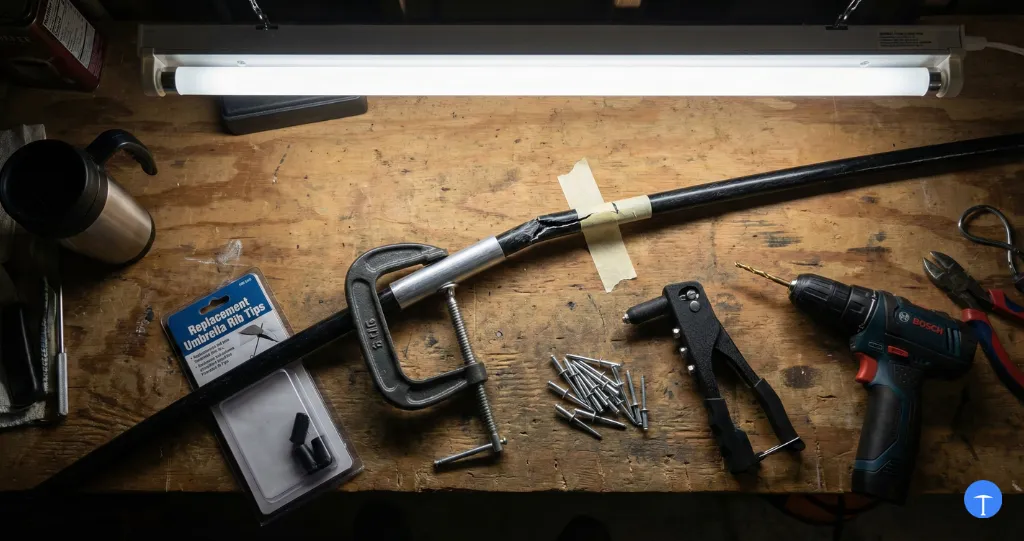
To fix a broken patio umbrella rib, splint the break using a copper sleeve and a small nut and bolt. This is the most reliable DIY patio umbrella rib repair method and holds up through multiple seasons. The whole job takes 30 to 45 minutes and costs under $10.
Broken ribs are the single most common patio umbrella failure. Wind gusts, improper closing, and general wear all cause them. You will spot the problem immediately: one section of the canopy droops because the rib underneath has snapped.
Copper is naturally weather resistant, so this splint won’t rust outdoors. A properly done repair adds two to four seasons of life.
For a faster temporary repair, cut a wooden dowel to about 6 inches, align it along the break, and secure with three or four zip ties spaced an inch apart. This is a bridge to a proper fix, not a permanent solution.
When the rib is cracked in multiple places, bent beyond straightening, or corroded where a splint won’t hold, full replacement is the better call. Patio umbrella replacement parts for ribs run $10 to $25 depending on material. Check whether your model uses aluminum or fiberglass ribs before ordering, since material affects both the replacement part and how it attaches to the patio umbrella hub. For a complete walkthrough of every rib repair method, see how to fix a patio umbrella rib.
To fix a broken patio umbrella string, remove the canopy, open the crank housing at the base of the pole, and route new 1/8 inch braided nylon cord through the internal pulley system. This patio umbrella string replacement (also called umbrella cord replacement) takes 60 to 90 minutes and is rated intermediate difficulty because cord routing varies by model.
A broken or tangled cord is usually the culprit when your patio umbrella won’t open, won’t close, or the crank spins without resistance. The cord connects the crank to the runner (the sliding piece that pushes the ribs open), and when it snaps or jumps a pulley, you need to restring patio umbrella cord from scratch.
Pull the canopy off by sliding the rib tips from the fabric pockets. Look down the pole from the top. If the cord is visibly frayed, kinked, or missing, that confirms the diagnosis. If the cord looks intact, the issue may be the crank mechanism itself.
For model-specific cord routing diagrams and instructions on how to restring a patio umbrella from start to finish, see the full restringing guide.
Umbrellas with an auto tilt mechanism route the cord through an additional pulley at the tilt point, adding complexity. Push-button tilt models run the cord straight through without interacting with the tilt joint. The dedicated restringing guide covers tilt routing in detail.
To fix a small canopy tear, apply outdoor fabric repair tape to both sides of the tear. This takes about 15 minutes and costs under $10. For tears longer than 6 inches or UV-brittle fabric, patio umbrella canopy replacement is usually more practical.
Clean the area around the tear with a damp cloth and let it dry. Cut repair tape about 1 inch larger than the tear on all sides. Apply to the outside, pressing firmly to seal. For a stronger hold, apply a second patch on the inside. Quality outdoor repair tape is UV resistant and waterproof.
Tears over 6 inches or in high-stress areas near rib tips benefit from stitching. Use heavy duty outdoor thread with a tight zigzag stitch. Fold the torn edges inward, sew closed, and apply a thin line of fabric adhesive over the seam to waterproof it.
When the fabric is faded, brittle, or torn in multiple places, replacing the entire canopy is faster and more effective. Replacement canopies run $30 to $80 depending on size and whether you go with standard polyester or premium Sunbrella fabric. The swap takes about 30 minutes: slide the old canopy off by pulling rib tips from the pockets, then slide the new one on in reverse. For a full walkthrough including sizing, see how to replace a patio umbrella canopy.
To fix a patio umbrella crank that won’t turn, apply silicone spray lubricant to the mechanism and work it back and forth. Most stuck cranks are caused by dried lubrication, debris, or minor corrosion, and a $5 can of silicone spray resolves the problem in about 10 minutes.
Lay the umbrella on its side for easier access to the crank housing. Spray silicone lubricant directly into the mechanism, coating the gears and visible moving parts. Turn the handle slowly in both directions to work it through. Use silicone spray specifically, not WD-40. WD-40 is a degreaser, not a long-term lubricant, and it attracts dust that gums up the mechanism over time.
If lubrication does not solve it, remove the crank housing cover screws. Look inside for leaves, dirt, sand, rust flakes, or anything jamming the gears. A stiff brush and compressed air clean out packed debris effectively. While the housing is open, inspect the gear teeth for stripping or cracks.
When the gear teeth are stripped (handle turns but nothing engages), the assembly needs replacing. Patio umbrella crank repair parts run $15 to $30 from most manufacturers. Match the old unit by noting pole diameter, gear type, and cord attachment method. Installation is the reverse of removal and takes 45 to 60 minutes. The full teardown is covered in the crank repair guide.
To fix a bent patio umbrella pole, insert a PVC pipe inside the pole as an internal sleeve reinforcing the weakened area. This patio umbrella pole repair method works for minor bends and costs under $10.
Measure the pole’s inner diameter and buy PVC that fits snugly inside. Cut to about 12 inches. Insert so it spans the damage with at least 4 inches past each side. If the fit is loose, wrap the PVC in electrical tape to tighten it. For added security, drill a small hole through both pole and sleeve on each end and bolt. This restores rigidity without adding visible bulk.
For bends near the tilt joint where internal sleeving is impractical, two hose clamps positioned on either side of the damage offer a quicker alternative. Less clean looking but functional.
If the pole is bent more than 15 degrees, kinked at a sharp angle, or corroded through at the bend, replacement is the safe call. A severely bent pole can fail suddenly under wind load, and a collapsing umbrella is a genuine safety hazard. Check whether your manufacturer sells individual pole segments, which is cheaper than full replacement. Use the umbrella size chart to verify pole dimensions when ordering. Full repair methods are covered in the pole repair guide.
To fix a leaning patio umbrella or wobbly setup, identify whether the wobble comes from the base connection, the tilt joint, or the pole itself. Each source has a different fix. If your umbrella is in a windy area, stability is especially critical, since an unstable umbrella can topple and cause injury.
The tilt joint (where upper and lower pole sections meet) is the most common wobble source. A $3 hose clamp tightened around the joint is the standard wobbly patio umbrella fix. Position the clamp just below the tilt point and tighten until snug but still tiltable. Works for both push-button and collar tilt designs.
If the pole rocks inside the base, the issue is a diameter mismatch. A cone wedge or pole adapter ring ($5 to $10) fills the gap. Make sure you are using a base that matches your umbrella in both diameter and weight.
For umbrella poles that sit in a table hole rather than a freestanding base, rubber or foam pole shims create a snug fit. In a pinch, a few wraps of electrical tape around the pole at the contact point work too. Make sure whatever you use is weather resistant.
To fix a broken umbrella tilt mechanism, start by identifying which type you have. Push-button tilt systems use a spring-loaded pin that locks the pole at preset angles. Auto tilt mechanisms use the crank to control both opening and tilting. Collar tilt designs use a rotating ring at the joint.
For push-button tilt, the most common failure is a worn locking pin that no longer catches. Replacement pins are inexpensive and press or screw in. For auto tilt, failures typically involve cord routing through the tilt pulley (covered in the cord section above). Collar tilt mechanisms can seize from corrosion, which silicone spray usually resolves. For a deeper look at how each system works, see understanding umbrella tilt mechanisms.
When the joint itself is loose, a pipe clamp just below the tilt point eliminates the slop without preventing intentional tilting.
To remove rust from a patio umbrella frame, scrub affected areas with a wire brush until you reach clean metal, apply rust converter spray, then seal with protective clear coat. Patio umbrella rust removal takes about an hour and costs $15 to $20.
Rust is most common on steel frames at joints, screw holes, and spots where the powder coating has chipped. Left untreated, it weakens structural integrity.
For deep pitting or visible metal thinning, the full rust removal guide covers when damage becomes a replacement indicator. Keeping your umbrella clean and dry between uses is the single best prevention.
Most patio umbrella repairs are preventable. A 15 minute seasonal patio umbrella maintenance routine extends lifespan by years.
Start of season: Inspect every rib for cracks or loose connections. Run the crank through several open/close cycles. Check for rust at joints and fastener points. Apply silicone spray to all moving parts. Examine the canopy for tears and mildew.
During the season: Close the umbrella when not in use. This single habit prevents more damage than any other maintenance step. Wind is the number one cause of broken ribs, bent poles, and torn canopies. Tighten the tilt joint and check base stability every few weeks.
End of season: Clean the canopy with mild soap and water. Lubricate all moving parts. Store indoors if possible, or use a weather-resistant cover. Make sure the umbrella is completely dry before covering — standing water accelerates corrosion and fabric degradation.
Annual hardware check: Tighten every nut, bolt, and screw. Replace any corroded or stripped hardware. This five minute check prevents sudden mid-season failures.
Most common patio umbrella repairs are straightforward DIY projects requiring basic tools and 30 to 90 minutes. Splinting a rib, replacing a cord, patching a canopy, and lubricating a crank are all within reach for anyone comfortable with a screwdriver and pliers. Professional services exist but typically cost more than a budget replacement, so they only make sense for premium models.
The most common cause is a broken, tangled, or frayed cord inside the pole. Remove the canopy, open the crank housing, and either untangle the existing cord or route new nylon cord through the pulley system. Less often, the crank gear is stripped and needs replacing. The full process is in the restringing guide.
The copper sleeve method. Flatten a 6 inch piece of 5/8 inch copper tubing over the break, drill through on each side, and secure with a nut and bolt. This creates a weather-resistant splint lasting multiple seasons without rusting.
If repair costs less than half a new umbrella’s price and the frame is structurally sound, yes. For budget umbrellas under $50 with multiple problems, replacement is almost always better. The cost guide helps benchmark replacement pricing.
A fix for a leaning patio umbrella depends on the source. Usually it is a loose tilt joint, bent pole, or undersized base. For a loose swivel joint, a $3 hose clamp around the connection is the quickest fix. For a bent pole, you may need PVC sleeve reinforcement or replacement.
Yes, and it is one of the easiest repairs. Replacement canopies cost $30 to $80. Slide the old canopy off by pulling rib tips from fabric pockets, then slide the new one on in reverse. The canopy replacement guide walks through the process.
Start with silicone spray lubricant worked back and forth. If that does not resolve it, open the crank housing and check for debris, corrosion, or stripped gears. Replacement assemblies run $15 to $30 and are a direct swap.
A proper rib splint or cord replacement lasts two to four additional seasons. Canopy replacements on a sound frame last as long as the original fabric. Consistent preventive maintenance makes the biggest difference in longevity — closing when not in use and annual lubrication are the two habits that matter most for any DIY umbrella repair.
Use this table to compare the cost of each repair against the value of your umbrella. Total up everything your umbrella needs and make a clear decision.
| Repair Type | Estimated DIY Cost | Time Required | Skill Level | Worth It If Umbrella Cost… |
|---|---|---|---|---|
| Single rib splint | $5–$10 | 30–45 min | Beginner | $75+ |
| Full rib replacement | $10–$25 | 45–60 min | Intermediate | $100+ |
| Cord/string replacement | $5–$15 | 60–90 min | Intermediate | $75+ |
| Small canopy tear patch | $5–$10 | 15–30 min | Beginner | Any price |
| Full canopy replacement | $30–$80 | 30–45 min | Beginner | $150+ |
| Crank mechanism replacement | $15–$30 | 45–60 min | Intermediate | $125+ |
| Pole sleeve reinforcement | $10–$20 | 30–45 min | Intermediate | $100+ |
| Tilt joint stabilization | $3–$5 | 10–15 min | Beginner | Any price |
| Rust treatment and coating | $10–$20 | 60–90 min | Beginner | $100+ |
| Complete rebuild (multiple issues) | $50–$100+ | 3–4 hours | Advanced | $250+ |
The 50% rule in practice: Add up every repair your umbrella needs, not just the most obvious one. If the total exceeds 50% of a comparable new umbrella’s price, buy new. For example, a broken rib ($8), fraying cord ($10), and rust treatment ($15) totals $33. On a $120 umbrella, that is about 27% and well worth repairing. But add a bent pole and torn canopy to the list, the total climbs past $60, and a $120 replacement starts looking smarter.
Frame integrity is the deciding factor. A sound pole and hub can support new ribs, cord, canopy, and crank hardware. Once the pole is severely bent, cracked, or corroded through, even cheap repairs are throwing money at a compromised foundation.
Age and condition matter. One broken rib on a three year old umbrella is routine wear. Three broken ribs plus fraying cord plus rust on a five year old umbrella is a replacement signal.
When it is time to replace, the best market umbrellas guide covers top options for table setups. For freestanding shade, the best cantilever umbrellas roundup is the reference. And if you are unsure what size fits your space, the patio umbrella size chart helps you measure and match before you buy.