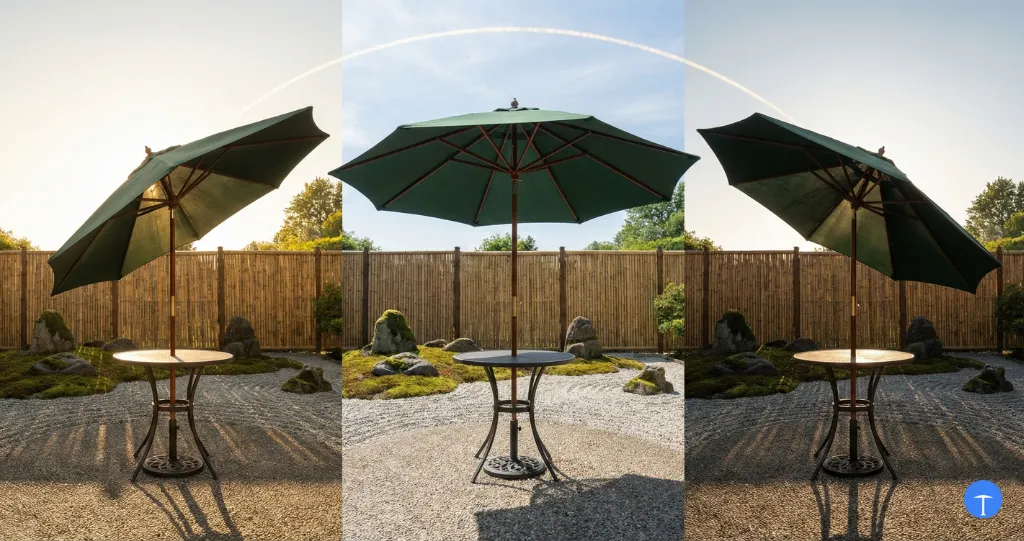
Umbrella tilt works through a pivot point built into the pole, typically just below where the canopy attaches. When you activate the tilt mechanism (pressing a button, turning a crank, or rotating a collar), you’re releasing or adjusting a locking system that allows the upper pole section to angle away from vertical. The canopy follows, redirecting shade as the sun moves.
That’s the simple answer. But if you’ve ever had a tilt mechanism fail, or you’re wondering why one umbrella costs three times more than another, the real story lives in the engineering. Understanding how these systems function helps you maintain them properly, diagnose problems, and make smarter buying decisions.
For a broader introduction to tilt options, our guide to understanding umbrella tilt mechanisms covers the basics.
Every tilt system relies on the same fundamental physics: a pivot point that allows rotation, a locking mechanism that holds position, and enough structural integrity to resist forces trying to snap everything back to vertical.
The pivot point sits where the upper pole section meets the lower, usually housed inside a metal or heavy-duty plastic assembly. This joint must rotate smoothly when you want adjustment and lock firmly when you don’t. Getting both right is harder than it sounds.
When you tilt a patio umbrella, you create leverage. The canopy acts like a sail, and wind load increases dramatically as the angle steepens. A 9-foot canopy tilted at 45 degrees in a 15 mph wind experiences significantly more stress at the pivot point than the same canopy sitting straight up. This is why tilt mechanisms fail more often than other umbrella components.
Most tilt systems offer between 15 and 45 degrees of adjustment from vertical. Some auto-tilt systems provide nearly continuous adjustment within that range, while simpler push-button designs lock into preset positions.
Before breaking down how each mechanism type works, here are the parts they all share. Every tilt system contains variations of these core components.
| Component | Function | Common Materials | Failure Risk |
|---|---|---|---|
| Tilt housing | Encases the pivot mechanism and protects internal parts from weather | Die-cast aluminum, reinforced nylon, ABS plastic | Medium: cracks from UV exposure or impact |
| Pivot joint | Allows the upper pole to rotate relative to the lower pole | Steel pin, brass bushing, plastic bearing | High: primary stress point during tilt operation |
| Locking pin/mechanism | Holds the canopy at the selected angle | Spring steel, hardened plastic, brass | High: repeated engagement causes wear |
| Hub connection | Joins the tilt assembly to the canopy’s rib structure | Aluminum, fiberglass-reinforced polymer | Medium: stress concentrates where ribs attach |
| Crank gears (where applicable) | Translates handle rotation into tilt adjustment | Zinc alloy, brass, reinforced plastic | Medium-High: gear teeth wear over time |
The tilt housing is a protective shell that keeps dirt, moisture, and debris away from moving parts. Better umbrellas use powder-coated aluminum housings that resist corrosion and UV degradation. Budget models often use injection-molded plastic that becomes brittle after a few seasons in direct sunlight.
The pivot joint takes the most abuse. Every adjustment creates rotational force while supporting the canopy’s weight. Quality umbrellas use hardened steel pins riding in brass or bronze bushings. Cheaper versions use plastic-on-plastic contact that wears quickly.
For a complete breakdown of every umbrella component, check out our guide to patio umbrella parts.
Each tilt type uses different engineering to accomplish the same goal. Understanding the mechanics explains why some feel smooth while others fight you, and why certain designs cost more.
Push-button tilt is the most straightforward design. The system uses a spring-loaded pin that engages with a notched track or series of holes drilled into a curved plate.
Pressing the button compresses a spring and retracts a metal or plastic pin from the track. This frees the upper pole to rotate. As you move the canopy to a new angle, the pin drags along until it drops into the next notch, locking the tilt in place. Release the button, and spring tension pushes the pin firmly into position.
The notched track typically offers three to five preset angles. You can’t stop between notches because there’s nothing for the pin to engage with. This is why push-button tilt feels “clicky” during adjustment.
Inside the housing, the spring sits in a small cylindrical chamber with the pin extending through a guide hole. Better designs use a coil spring around the pin shaft, while budget versions sometimes use a flat leaf spring that fatigues faster.
The limitation is precision. You get whatever angles the manufacturer decided to drill. If the sun falls between two preset positions, you choose the closer option.
Crank tilt adds mechanical complexity for more adjustment range. These systems use a gear mechanism, typically a worm drive, that translates crank handle rotation into tilt movement.
A worm drive consists of a threaded shaft (the worm) engaging with a toothed wheel (the worm gear). When you turn the crank, the worm rotates and pushes the teeth of the worm gear, which connects to the tilt pivot. The genius of worm drives is that they’re self-locking. The gear can’t spin the worm backward, so the canopy stays put without a separate locking pin.
Some crank tilt systems use a simpler ratchet mechanism. You crank one direction to tilt, and the ratchet holds position until you release and crank back. These aren’t as smooth as worm drives but cost less to manufacture.
The crank handle connects to the gear system through the pole, usually running to a hub near the base. This means crank tilt umbrellas have mechanical components running the full pole length, adding potential failure points but distributing stress across a longer assembly.
For practical trade-offs between these options, our comparison of push-button tilt vs crank tilt breaks down the differences.
Collar tilt (sometimes called ring tilt) is the simplest mechanism, relying entirely on friction to hold position.
The “collar” is a ring around the pole at the pivot point. Tightening compresses a friction surface against the joint, preventing rotation. Loosening allows free movement. No springs, no gears, no pins.
Inside, you’ll find either a split-ring design that squeezes the pole when twisted, or a threaded collar pressing a friction pad against the pivot housing. The friction surface might be rubber, nylon, or metal-on-metal.
The advantage is durability through simplicity. Almost nothing can break. The disadvantage is convenience. You need two hands to adjust, and the canopy drifts to whatever angle balances its weight until you lock it down.
Collar tilt shows up most on commercial-grade umbrellas where longevity matters more than convenience.
Auto-tilt represents the most sophisticated engineering, combining canopy opening and tilt adjustment into a single crank operation using a dual-stage gear mechanism.
The crank connects to a gear assembly controlling both lift and tilt mechanisms. During the first cranking phase, only lift gears engage and the canopy opens. Once fully open, continued cranking activates the tilt gears.
The transition happens through a clutch or automatic gear shift when the lift mechanism reaches its limit. Better auto-tilt systems use planetary gear sets for smooth transitions and fine control.
The result is essentially infinite adjustment within the tilt range. No preset positions. The worm drive lets you stop at any angle. Combined with one-handed operation, this makes auto-tilt the premium residential option.
The trade-off is complexity. More gears mean more parts that can wear or strip, and auto-tilt mechanisms tend to be heavier.
Material quality separates umbrellas that last a decade from those that fail in two seasons.
The pivot joint is the best longevity predictor. A steel pin in a brass bushing will outlast a plastic pin in a plastic sleeve by five times or more. Brass provides low-friction contact that doesn’t gall under pressure and resists corrosion.
Gear teeth matter in crank and auto-tilt systems. Die-cast zinc alloy gears hold up well but can crack under shock loads. Brass gears are softer but forgiving. Plastic gears strip fastest, especially when hot.
Housing construction affects survival outdoors. Powder-coated aluminum resists rust and UV damage. ABS plastic holds up but gets brittle. Cheap polypropylene warps in sunlight, throwing mechanisms out of alignment.
Moving parts correlate with failure opportunities. Push-button systems have few. Collar tilt has even fewer. Auto-tilt has the most.
Umbrellas with built-in wind vents often have beefier tilt mechanisms since manufacturers expect more stress. Worth considering in breezy locations.
Knowing what breaks and why helps you spot problems early.
Stripped locking pins happen in push-button systems when the pin wears or notches round off. Every engagement grinds surfaces together. Eventually the pin won’t hold.
Frozen pivots occur when corrosion or debris seizes the joint. Aluminum contacting steel is prone to galvanic corrosion if moisture enters. Sand and grit act like grinding compound.
Stripped gears plague crank and auto-tilt systems with plastic components. Failure often happens suddenly. The crank spins freely but nothing moves.
Cracked housings result from UV degradation, impact, or water freezing inside. Cracks let in more moisture, accelerating corrosion.
Spring fatigue makes push-button mechanisms sticky. The spring loses tension and can’t engage the locking pin fully.
If your button mechanism has failed, our guide on how to tilt an umbrella without the button covers workarounds.
Simple repairs are possible. Replacing a worn locking pin, cleaning a sticky pivot, or tightening a loose collar are reasonable DIY jobs. Gear replacement is harder since sourcing exact parts is tricky, and mismatched gears strip quickly. For complex auto-tilt systems, manufacturer repair or replacement usually makes more sense.
Corrosion and debris are the usual culprits. Moisture combines with salt air or pool chemicals to create oxidation that binds moving parts. Sand, pollen, and dirt add friction. Dried lubricant gums up too. Regular cleaning and lubrication prevent most stiffness.
Absolutely. Metal components handle repeated stress far better and resist environmental degradation. Quality engineered plastics perform well in lower-stress roles like housings. The critical difference shows at high-load points like pivot pins and gear teeth, where plastic fails years earlier.
Yes, and you should. Silicone spray or white lithium grease once a season keeps pivots moving smoothly and protects against corrosion. Avoid petroleum-based lubricants on plastic since they cause degradation. Wipe away excess to avoid attracting dirt.
The click comes from the spring-loaded pin snapping into position. When clicking stops, either the spring has lost tension or the pin isn’t reaching the notches. Spring fatigue is common after several years. The pin can also get bent, corroded, or coated with gunk. Sometimes the track wears smooth.
Umbrella tilt mechanisms range from the dead-simple friction collar to complex auto-tilt gear trains. Each trades off between ease of use, precision, durability, and cost. Push-button tilt offers reliability through simplicity. Crank tilt adds fine adjustment with more moving parts. Collar tilt provides maximum durability when convenience isn’t the priority. Auto-tilt delivers smooth one-handed operation with the most potential failure points.
Whatever type you have, the pivot joint and locking mechanism are where quality matters most. Those components handle dynamic stress that eventually wears out every tilt system. Understanding how they work helps you maintain what you have and recognize value when shopping.
Looking at offset umbrellas? Those use completely different positioning systems. And if canopy shape is on your mind, our comparison of round vs square patio umbrellas covers how shape affects coverage and wind handling.