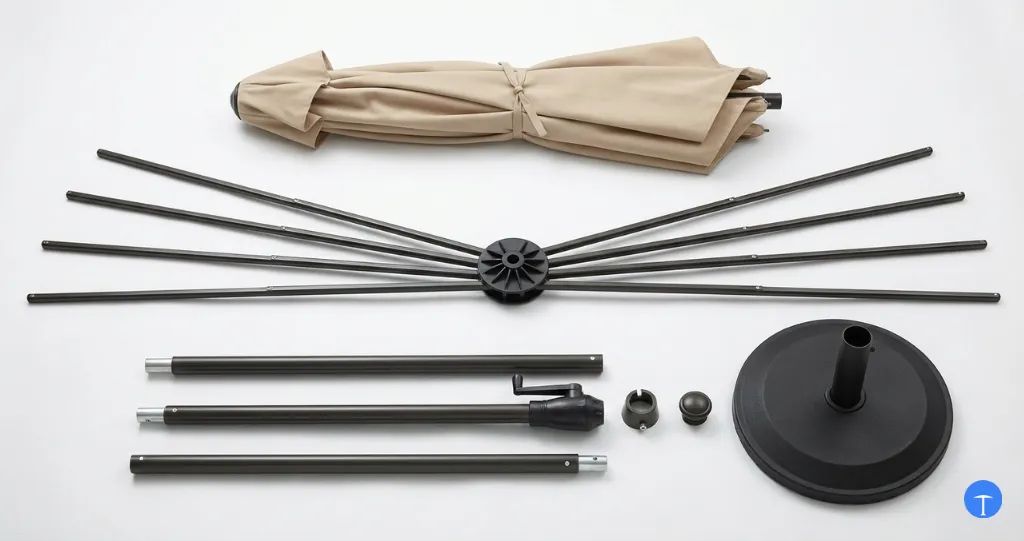
Understanding the parts of a patio umbrella helps you make smarter buying decisions and handle repairs without replacing the whole unit. Whether you’re shopping for a new umbrella or trying to figure out why yours stopped opening, knowing what each component does saves you time and money. This guide breaks down every part of a patio umbrella, from the canopy down to the base, so you can identify exactly what you’re looking at. Think of it as your patio umbrella diagram in words.
The canopy is the fabric top that provides shade and protection from the elements. It’s the most visible part of your umbrella and often the first component to show wear. Canopies come in different materials, panel counts, and shapes, all affecting how well the umbrella performs over time.
Fabric Materials
Most canopies use polyester (affordable but fades in 1-2 seasons unless solution-dyed), olefin (better fade resistance, dries quickly), or Sunbrella acrylic (the gold standard with 5-10 year fade warranties).
What to Look For
Check the fabric’s UV protection rating if listed. A canopy with UPF 50+ blocks over 98% of UV rays. Water resistance matters too, especially if you leave your umbrella outside. Look for fabrics treated with a water-repellent coating rather than relying on the weave alone.
Panel count affects both appearance and durability. Most umbrellas have 6 or 8 panels. Eight-panel canopies distribute tension more evenly and tend to hold their shape better in wind. If you’re deciding between round or square patio umbrellas, keep in mind that rectangular canopies often have more panels to maintain structural integrity.
The ribs are the support structure directly under the canopy, radiating outward from the center hub like spokes on a wheel. Stretchers are the smaller arms that connect each rib to the sliding runner mechanism. Together, they form the skeleton that keeps your canopy taut and properly shaped.
Rib Materials
Steel ribs are strong but prone to rust. Aluminum offers lightweight durability and rust resistance. Fiberglass flexes instead of snapping, making it ideal for windy areas. Wood ribs (common on market-style umbrellas) look beautiful but need more maintenance. According to the Casual Furniture Retailers Association, fiberglass ribs are the top choice for regions with frequent wind.
Rib Count
More ribs generally mean better canopy support and wind resistance. Budget umbrellas often have 6 ribs, while quality options run 8 ribs or more. Some commercial-grade umbrellas feature double-ribbed construction for extra durability.
What to Look For
Examine where the ribs connect to the hub and stretchers. Riveted connections last longer than plastic clips. If you’re dealing with a broken umbrella rib, measure both the length and the thickness at the connection point before ordering a replacement, as these vary significantly between brands.
The hub sits at the top center of the umbrella where all the ribs connect. The runner is the sliding collar that moves up and down the pole when you open and close the umbrella. When you turn the crank or push the umbrella open, the runner travels upward, pushing the stretchers outward, which spreads the ribs and opens the canopy.
This is where patio umbrella anatomy gets mechanical. The hub, runner, and stretcher system work together as the opening mechanism. Quality here directly impacts how smoothly your umbrella operates and its longevity.
What to Look For
Metal hubs and runners outperform plastic ones in every way. Look for thick, die-cast aluminum construction on the hub. The runner should slide smoothly without wobbling. Test the mechanism several times before buying if possible. A gritty or jerky motion usually means lower quality components or poor alignment.
The pole is the vertical shaft that supports the entire umbrella structure. It runs from the base up through the canopy, and its material and diameter determine overall stability and durability.
Pole Materials
Aluminum is the most popular choice: lightweight, rust-proof, and strong enough for residential use. Steel is heavier and stronger but needs powder coating to prevent rust. Wood poles (teak, eucalyptus) offer a traditional look but require periodic sealing. Fiberglass poles are rare but extremely lightweight.
Pole Diameter
Standard residential umbrella poles measure 1.5 inches (38mm) in diameter. Commercial umbrellas often use 2-inch poles for added stability. The pole diameter must match your base opening, so measure carefully before buying replacement parts or a new base.
One-Piece vs. Two-Piece
Two-piece poles separate in the middle for easier storage. The joint creates a potential weak point, though quality designs with solid connection hardware perform nearly as well as one-piece poles. One-piece poles offer maximum rigidity for permanent installations.
The tilt mechanism allows you to angle the canopy to follow the sun throughout the day. It’s typically located either at the top of the pole near the hub or partway down the pole depending on the tilt type.
Different umbrellas use different tilt systems. Push-button tilt, crank tilt, and collar tilt each work differently. For a deep dive into how these systems function, see our guide on understanding umbrella tilt mechanisms. If you’re comparing options, our push-button tilt vs crank tilt comparison covers the practical differences.
Have an older umbrella without a working button? Check out how to tilt an umbrella without a button for workarounds.
The crank handle is the rotating arm used to open and close crank-lift umbrellas. Turning the crank winds a cord or gear mechanism that raises or lowers the runner. Most residential umbrellas use this system because it requires less effort than manual push-up designs.
What to Look For
Metal crank handles with comfortable grips last longer than all-plastic versions. The crank housing (where the umbrella crank mechanism lives inside the pole) should be sealed or protected from moisture. Geared systems provide smoother operation than simple rope-and-pulley setups.
Crank mechanisms are one of the more failure-prone umbrella components. Listen for grinding or clicking sounds when operating, which signal worn gears or a fraying lift cord.
The finial is the decorative cap that sits on top of the umbrella, covering the hub where the ribs meet. While primarily aesthetic, it also protects the hub mechanism from rain and debris.
Finials come in various styles from simple round caps to ornate pieces. On wood umbrellas, they often match the pole material. Plastic finials work fine but can crack or fade faster than metal versions.
Umbrella finial replacement is one of the easiest repairs you can do. Just measure the hub opening diameter before ordering a new one.
The wind vent is an opening near the top of the canopy, usually featuring a secondary layer of fabric. Rather than acting as a solid sail, the vent allows wind to pass through the umbrella, reducing the lifting force that can flip or damage your umbrella in gusts.
Vented canopies significantly improve wind stability. If you live in a breezy area, this feature matters more than most. For detailed information on vent types and how much difference they actually make, see our complete guide on umbrella wind vents explained.
The base is the weighted foundation that keeps your freestanding umbrella upright. It sits on the ground with the pole inserted into a center tube. Getting the right base is critical because an undersized base is the leading cause of tip-overs.
Base Materials
Concrete bases are heavy and affordable but can crack in freeze-thaw climates. Steel plates are compact and very stable. Plastic bases filled with water (about 35 lbs) or sand (about 50 lbs) allow easy repositioning. Granite or stone bases offer a premium look and excellent weight.
Base Weight Guidelines
The Hearth, Patio & Barbecue Association recommends about 10 pounds of base weight per foot of canopy diameter. A 9-foot umbrella needs at least 90 pounds. Add more weight for windy locations or tilted umbrellas since tilting increases wind leverage on the base.
What to Look For
The base tube diameter must match your pole diameter. Standard is 1.5 inches, but always verify. Some bases include adapter rings for different pole sizes. Check that the set screw or locking mechanism grips the pole securely without stripping.
The ferrule is the bottom portion of the pole that inserts into the base. Some umbrellas have a separate ferrule piece while others have an integrated design. If your ferrule is damaged, the pole won’t sit properly in the base.
Umbrella components range dramatically in quality, and those differences explain the price gap between a $50 big-box umbrella and a $500 commercial-grade unit. Here’s how quality varies across key parts:
| Part | Budget Quality | Mid-Range Quality | Premium Quality |
|---|---|---|---|
| Canopy | Basic polyester, fades in 1-2 seasons, minimal water resistance | Solution-dyed polyester or olefin, 3-4 year color retention | Sunbrella acrylic, 5-10 year fade warranty, excellent water resistance |
| Ribs | 6 thin steel ribs, prone to rust and bending | 8 aluminum ribs, decent flex and durability | 8+ fiberglass ribs or double-ribbed construction, maximum wind resistance |
| Pole | Thin-wall steel or aluminum, 1.5” diameter, wobbles under stress | Solid aluminum, 1.5-1.75” diameter, stable | Thick-wall aluminum or hardwood, 2”+ diameter, commercial grade |
| Hub/Runner | Plastic construction, sticks or jams over time | Metal hub with plastic runner, functional for several years | All-metal die-cast construction, smooth operation, long lifespan |
| Base | Lightweight plastic, under 30 lbs filled, tips easily | 50-70 lb concrete or filled plastic, adequate for calm days | 80-100+ lb steel or granite, stable in moderate wind |
When budgeting, prioritize the canopy and ribs. These take the most abuse from sun and wind and fail most often on cheap umbrellas. A quality canopy on a mid-range frame outperforms a budget canopy on any frame.
Knowing which umbrella replacement parts wear out most often helps you plan repairs rather than full replacements:
Canopy: Sun damage causes fading and fabric breakdown. Many manufacturers sell replacement canopies for their frames. Measure your existing canopy diameter and rib count before ordering.
Lift cord: The rope inside crank mechanisms frays with use. Replacement cords are inexpensive, though installation requires disassembly.
Crank handle: Plastic handles crack; metal handles occasionally strip. Usually sold as a handle-and-gear assembly.
Ribs: Individual ribs can bend or snap in wind. Replacements must match length and connector style exactly.
Finial: Easy to replace if lost or broken. Match the hub opening diameter.
For most repairs, you’ll need the umbrella brand and model number (check the pole or original packaging). Generic parts exist for cords and finials, but ribs, hubs, and runners are typically brand-specific.
The lift cord inside crank mechanisms fails most frequently, especially on umbrellas used daily. Canopy fabric degradation from UV exposure is next most common. Ribs bending or breaking comes third, usually from wind damage or improper storage.
It depends on the part. Lift cords, finials, and bases tend to be fairly universal as long as measurements match. Ribs, hubs, runners, and canopies are usually brand-specific because dimensions and attachment methods vary. Always note your umbrella’s brand and model before shopping for parts.
Use a tape measure or calipers to measure across the widest point of the pole (the outside diameter). Standard residential poles are 1.5 inches (38mm). Measure near the ferrule since some poles taper slightly. Write this number down before shopping for bases or accessories.
Repair makes sense for isolated issues: a broken cord, cracked finial, single bent rib, or faded canopy on an otherwise solid frame. Replace the whole umbrella if multiple ribs are bent, the hub or runner mechanism is cracked, the pole is bent or corroded through, or repairs would cost more than 50% of a new comparable umbrella.
You can absolutely replace just the canopy if the frame is in good condition. Many manufacturers sell replacement canopies for their current models, and aftermarket options exist for common umbrella sizes. Measure your canopy diameter, count the ribs, and check if your umbrella uses a specific attachment method. A new canopy on a solid frame costs a fraction of a full umbrella replacement.
Every part of a patio umbrella works together to provide shade and withstand the elements. Now that you understand what each component does, you can make better decisions whether you’re buying new, troubleshooting a problem, or ordering replacement parts. Focus your budget on quality where it counts most (canopy and ribs), make sure your base matches both your pole diameter and umbrella size, and don’t overlook features like vented canopies if wind is a concern in your area.
For more guidance on choosing the right umbrella setup, explore our patio umbrella guides covering everything from tilt mechanisms to shape comparisons.