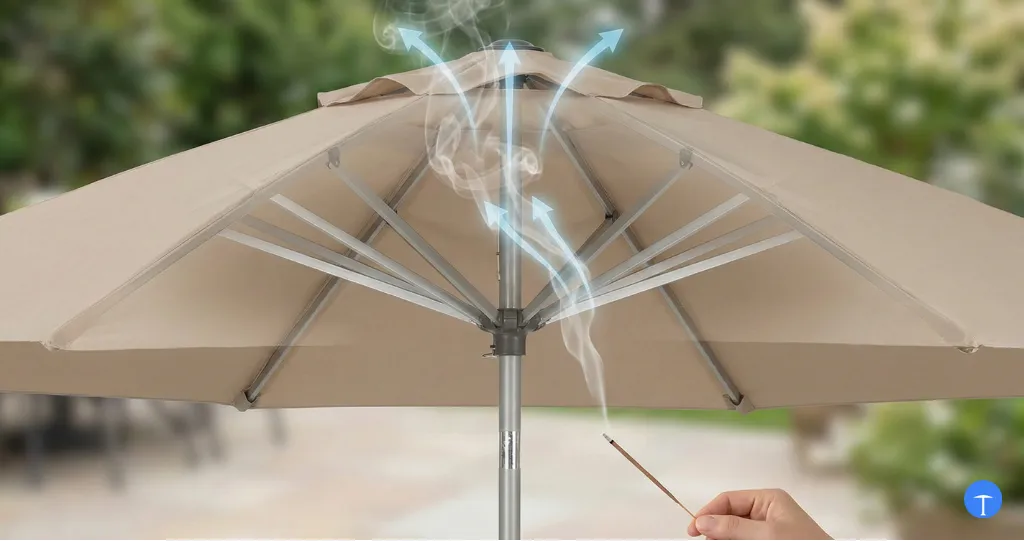
Wind vents are small openings at the top of a patio umbrella canopy that let air pass through instead of catching underneath and flipping your umbrella inside out. If you’ve ever watched a gust turn someone’s umbrella into a sail, you’ve seen exactly why these vents exist. They’re a simple feature that solves the common problem of an umbrella blowing over in moderate wind.
An umbrella wind vent is a circular opening cut into the canopy fabric near the top of the umbrella, usually within a foot of the center pole. The opening is covered by an additional layer of fabric that sits slightly above the main canopy, creating a gap that allows canopy ventilation while still blocking sun and light rain.
Think of it as a controlled escape route for air. The vent itself is typically 8 to 12 inches in diameter, though this varies by umbrella size. On most designs, you’ll notice the vent fabric either matches the main canopy or uses a contrasting color for visual interest.
The placement matters. Vents sit at the highest point of the canopy because that’s where air pressure builds most intensely when wind hits the umbrella from below. If you want to understand how this fits with other parts of a patio umbrella, the vent works in coordination with the ribs and frame to distribute stress across the entire structure.
From an aesthetic standpoint, a vented patio umbrella often looks more finished than solid canopy designs. The layered appearance suggests quality construction, and some manufacturers offer two-tone vent options where the inner panel uses a complementary color.
Wind vents work through umbrella pressure release, allowing trapped air to escape before it builds enough force to flip or damage your umbrella. When wind blows across your patio, air currents swirl underneath the canopy and push upward, creating lift.
Without a vent, that trapped air has nowhere to go. Pressure builds until something gives, usually the umbrella itself. The canopy catches wind like a parachute, the frame flexes beyond its limits, and suddenly you’re chasing your umbrella across the yard.
A patio umbrella vent breaks this cycle by giving air an exit path. As pressure builds underneath, air flows upward and out through the vent opening. The canopy stays relatively stable because it’s no longer fighting against trapped air trying to escape.
The physics are straightforward: reduce pressure differential, reduce lift. Manufacturers report that vented designs handle wind speeds 10 to 15 mph higher than equivalent non-vented models before showing instability. Some brands now include an umbrella wind rating in their specs, though there’s no industry standard for how these ratings are measured.
This doesn’t make your umbrella windproof. Nothing short of bringing it inside accomplishes that. But a vent buys you meaningful margin in moderate wind conditions.
The single vent vs double vent decision comes down to your conditions and umbrella size. Single vent umbrellas have one opening at the top. Double vent designs add a second tier, creating two stacked vent layers with separate air passages.
A double vent umbrella releases more air pressure because it provides two escape routes instead of one. The layered design also creates additional turbulence that helps break up wind energy before it can build momentum under the canopy.
Single vents work well for most residential situations. They provide adequate pressure release for umbrellas up to about 9 feet in diameter and handle typical afternoon breezes without issue.
| Feature | Single Vent | Double Vent |
|---|---|---|
| Wind resistance | Good for moderate conditions | Better for sustained or gusty wind |
| Shade reduction | Minimal (2-3% of canopy area) | Slightly more (4-5% of canopy area) |
| Aesthetic options | Standard appearance | More visual dimension and layering |
| Price impact | Base pricing | Typically $20-50 premium |
| Best for (umbrella size) | Up to 9 ft diameter | 10 ft and larger |
| Common on | Market umbrellas, residential models | Cantilever umbrellas, commercial grade |
If you’re shopping for a windproof patio umbrella, double vents appear more frequently on models specifically engineered as wind resistant umbrellas. But the vent alone doesn’t determine overall stability. Frame construction, base weight, and canopy material all factor into how well an umbrella actually performs.
Yes, but barely enough to matter in practice. A single umbrella air vent opening represents roughly 2 to 3 percent of the total canopy area. You’re not going to notice a spotlight of sun coming through while you’re sitting underneath.
The vent fabric that covers the opening blocks direct sunlight anyway. It’s not an open hole in your shade coverage. The gap between layers is angled and small enough that sun rays at typical daytime angles don’t pass straight through.
What vents do affect is heat buildup. That’s actually a benefit. Hot air rises and collects under solid canopies, making the space beneath feel stuffy on warm days. Vents let that hot air escape, improving comfort through better canopy ventilation. If you’ve ever sat under a vented umbrella versus a solid one on an 85 degree afternoon, you’ve felt this difference.
For shade coverage purposes, your umbrella shape and size matter far more than whether it has a vent. A 9 foot round umbrella with a vent provides better shade than a 7 foot solid umbrella simply because of the additional coverage area.
Certain situations make vents practically essential rather than just nice to have.
Coastal properties and lakefront locations deal with consistent breeze patterns. Even on calm days, water proximity creates thermal winds as land and water temperatures shift. A vent helps your umbrella handle these predictable but persistent breezes.
Open yards without windbreaks expose umbrellas to the full force of passing gusts. Fences, buildings, and trees all disrupt wind before it reaches your patio. Without these natural buffers, your umbrella takes the hit directly.
Large umbrellas over 9 feet catch more wind by simple geometry. More surface area means more force when wind hits. The relationship between umbrella shape and wind load matters here too. Square and rectangular canopies present flat edges that catch gusts differently than round designs. Double vents become worth considering at larger sizes.
Elevated decks and rooftop patios sit above the ground level turbulence that naturally slows wind near surfaces. Higher elevation means faster, more consistent wind exposure.
If you’re also using tilt mechanisms to track the sun throughout the day, a vent becomes more valuable. Tilted umbrellas present a larger profile to horizontal wind. Understanding how umbrella tilt works helps you position for both sun coverage and wind resistance.
Not every patio needs a vented patio umbrella. Some conditions make them unnecessary.
Enclosed or partially covered patios already have wind protection built into the space. If three walls surround your seating area or you’re under a pergola that disrupts airflow, wind rarely builds enough force to matter.
Small umbrellas under 7 feet don’t catch enough wind to create serious lift problems. Market umbrellas in this size range often skip vents entirely because the physics don’t demand them.
Consistently calm climates exist, though they’re rarer than people assume. If you genuinely live somewhere that never gets afternoon breezes or seasonal wind patterns, vents provide no functional benefit.
Temporary or portable setups that you bring inside at the first sign of wind don’t need vents as urgently. If your routine includes closing the umbrella whenever conditions pick up, you’re managing wind manually.
One consideration: if you’re choosing between a push button tilt umbrella without a vent and a similar model with one, the vented option usually costs only marginally more. Even in calm conditions, the vent provides insurance against the occasional surprise gust.
Not all vents are created equal. Cheap construction can make a vent a weakness rather than a strength.
Reinforced stitching around the vent opening matters most. This area experiences stress every time wind passes through. Look for double or triple stitching around the perimeter. Single stitch lines on vent edges suggest corners were cut.
Fabric quality matching the main canopy indicates thoughtful construction. The vent panel should use the same material weight and UV treatment as the rest of the umbrella. Lighter vent fabric will fade and degrade faster.
Proper grommet or binding at connection points where the vent attaches to the main canopy prevents tearing. Metal grommets or reinforced binding tape distribute stress across a wider area.
Vent panel tension when the umbrella opens tells you about fit. The panel should sit taut but not drum tight. Loose panels flap noisily and wear faster. Overly tight panels stress the attachment points constantly.
On higher quality umbrellas, vent construction matches the overall build standard. Premium frames typically come with well executed vents because manufacturers building to that standard apply it consistently.
Technically yes, but it’s rarely worth doing. Cutting into canopy fabric weakens the surrounding material, and achieving proper sealing around a DIY vent opening is difficult. The reinforcement and finishing that factory vents include would need to be replicated by hand. In most cases, you’re better off replacing the umbrella with a vented model when the time comes.
In normal rain, no. The overlapping vent design sheds water outward before it can drop through the gap. Heavy downpours with wind may push some water through at angles, but by that point you shouldn’t be under the umbrella anyway. For typical use, vents don’t create rain leakage problems.
Beach umbrellas face consistently windy conditions plus the challenge of anchoring in sand, which provides less grip than weighted bases on solid surfaces. Vents help significantly in beach environments, reducing the chance of your umbrella blowing over when a gust hits. Most quality beach umbrellas include them standard for this reason.
Yes. The vent area sees repeated stress and UV exposure. On lower quality umbrellas, vent stitching often fails before the main canopy shows wear. Inspect vent seams annually if your umbrella stays outside regularly. Early signs of thread fraying or fabric pulling at attachment points mean replacement should be on your radar.
Wind vents earn their place on most patio umbrellas. The umbrella stability benefit in moderate wind outweighs the minimal shade reduction and slight price premium. For umbrellas 9 feet or larger, in exposed locations, or anywhere afternoon breezes are common, consider vents essential rather than optional.
Skip vents only if you have genuine wind protection from structures, use a small umbrella, or bring your setup inside at the first hint of breeze. For everyone else, the math favors vented designs. They extend the usable conditions for your umbrella, reduce stress on the frame, and prevent the frustration of constantly adjusting or chasing a flipped canopy across your yard.
When shopping, treat vent quality as a proxy for overall construction standards. Well executed vents with reinforced stitching and matched fabric suggest an umbrella built with attention throughout. Sloppy vent construction usually indicates shortcuts elsewhere in the design too.