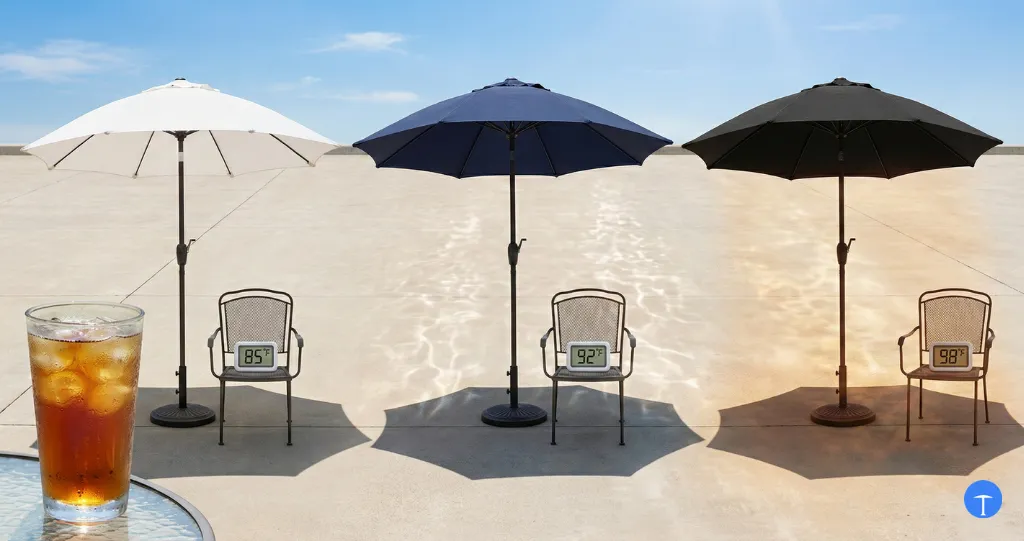
White and light colored patio umbrellas are the coolest in terms of temperature underneath. They reflect more solar heat, which means less energy gets absorbed by the canopy and less warmth radiates down to where you’re sitting. In controlled comparisons, the area under a white or cream umbrella can be 10 to 15 degrees Fahrenheit cooler than under a black or dark colored umbrella of the same size and fabric.
But there’s a catch. Darker colors block significantly more UV radiation. So the coolest color isn’t automatically the best color, and the answer depends on what matters more to you: staying cool or staying protected from UV. For most people, the best compromise is a medium to dark saturated color like navy, forest green, or burgundy in a UPF rated fabric. That combination balances heat management with strong UV protection.
The physics here are straightforward. Light colors reflect a higher percentage of incoming solar radiation. When sunlight hits a white or cream canopy, most of that energy bounces away. Less heat gets absorbed by the fabric, and less heat reradiated downward to your seating area.
Dark colors do the opposite. A black or navy canopy absorbs more solar radiation, which heats the fabric itself. That warm fabric then radiates some of that energy downward, raising the temperature underneath. The temperature difference between a white and black umbrella canopy can range from 10 to 15 degrees Fahrenheit depending on conditions like direct sun intensity, wind, humidity, and how high the canopy sits above your seating area.
Fabric type matters alongside color, too. A thick, UV coated dark fabric may actually perform better than a thin, uncoated white fabric because of how the coating handles heat transmission. And wind plays a significant role. In breezy conditions, the temperature gap between light and dark canopies narrows considerably because moving air dissipates the radiated heat before it reaches you. This applies equally whether you’re using a market umbrella, an offset model, or a cantilever setup, since the color behavior is about the fabric, not the frame.
Darker and more saturated colors absorb UV radiation rather than letting it pass through the fabric weave. A black or navy canopy in the same material blocks meaningfully more UV than a white or pastel version of that same fabric. White and very light fabrics allow more UV to transmit through to the space below.
This creates a genuine trade off. The color that keeps you coolest (white) provides the least UV protection in the same fabric, and the color that blocks the most UV (black) creates the warmest space underneath. If you want to understand how UV protection works across different umbrella types and fabrics in more detail, our guide on whether all umbrellas provide UV protection covers the topic thoroughly.
One important note: with UPF rated fabrics like Sunbrella and other solution dyed acrylics, the trade off becomes less pronounced. Even lighter colors in these engineered fabrics achieve high UV blocking ratings. But in standard polyester, color makes a big difference in how much UV gets through to you.
Here’s the simplified decision. If your only concern is staying cool, choose white, cream, or light gray. If your only concern is UV protection, choose black, navy, or dark forest green. If you want the best balance of both, choose medium to dark saturated colors like navy, forest green, burgundy, or chocolate brown, ideally in a UPF rated fabric.
The compromise colors work because they’re dark enough to block substantial UV while not absorbing quite as much heat as pure black. Navy, for example, provides nearly the UV blocking performance of black but runs several degrees cooler underneath. Pair that with a quality fabric, and you get a setup that handles both priorities well. For a broader look at what patio umbrellas block UV and how to evaluate them, see our UV blocking overview.
The following table ranks common patio umbrella colors from coolest to warmest, along with their UV blocking performance in both standard and UPF rated fabrics. Temperature differences are approximate and measured against a white umbrella as the baseline under similar conditions.
| Umbrella Color | Heat Reflection | Temp. Underneath | UV (Standard) | UV (UPF Rated) | Best For |
|---|---|---|---|---|---|
| White/Off White | Highest | Coolest (baseline) | Low to Moderate | Excellent | Hot climates, heat relief priority |
| Light Gray/Silver | Very High | Very Cool (+1 to 3°F) | Low to Moderate | Excellent | Heat relief with neutral aesthetic |
| Pastels | High | Cool (+2 to 5°F) | Moderate | Excellent | Decorative, cooler setups |
| Medium Tones (Tan/Khaki) | Moderate | Moderate (+5 to 8°F) | Good | Excellent | Balanced heat and UV |
| Navy/Green/Burgundy | Low to Moderate | Warm (+8 to 12°F) | Very Good | Excellent | Best compromise: UV + comfort |
| Black | Lowest | Warmest (+10 to 15°F) | Highest | Excellent | Maximum UV blocking; manageable heat in windy locations |
When it comes to blocking UV radiation in the same fabric, the ranking essentially reverses the cooling list. Black blocks the most UV across all fabric types. Navy, dark green, and dark red follow closely. Medium saturated colors like royal blue, red, and teal provide good UV blocking that’s noticeably better than pastels. Light colors and white block the least UV in standard fabrics, though UPF rated white fabrics can still achieve excellent protection ratings.
The key takeaway is that fabric quality and color work together. If you’re choosing between umbrella colors and UV protection matters to you, either go darker or invest in a UPF rated fabric that compensates for lighter colors. Understanding the right umbrella size for your space also matters for shade coverage, and our patio umbrella size chart can help with that.
The right color depends on your specific setup and priorities. Here’s a breakdown by common scenarios.
Go with white, cream, light gray, or silver. These reflect 80 to 90% of solar radiation, creating the coolest space underneath. Pair with a UPF rated fabric so you’re not sacrificing UV protection for comfort.
Navy, forest green, or black in any fabric will give you the strongest UV absorption. Even in standard polyester, these colors block significantly more UV than lighter options.
Navy or forest green in a UPF rated fabric gives you the best of both worlds. Your guests stay reasonably cool, and everyone gets solid UV protection without thinking about it. These colors also tend to complement most outdoor furniture and decor. If you’re exploring different umbrella styles for your entertaining space, our guide to types of patio umbrellas covers the options.
Choose darker UPF rated colors. Water and concrete reflect UV upward, which increases your UV exposure from below. A dark canopy overhead blocks the direct UV while the UPF rating handles the intensity. This is one scenario where the UV blocking priority should outweigh the cooling priority.
When a roof or pergola already provides partial coverage, the umbrella color matters less for UV since the structure handles much of the blocking. Choose based on what looks good in your space and how much additional heat management you want.
| Your Priority | Recommended Colors | Fabric Advice | Why |
|---|---|---|---|
| Maximum Cooling | White, cream, light gray, silver | UPF rated fabric recommended to offset lower UV blocking | Reflects 80 to 90% of solar radiation for coolest space underneath |
| Maximum UV Protection | Black, navy, dark forest green | Any fabric; even standard polyester in these colors blocks high UV | Dark colors absorb UV instead of transmitting through fabric |
| Best Compromise | Navy, forest green, burgundy, chocolate | UPF rated fabric ideal but not required | Dark enough for strong UV blocking without the peak heat of black |
| Pool/Reflective Surfaces | Navy, forest green, dark colors | UPF rated fabric strongly recommended | Reflected UV from water and concrete increases exposure from below |
| Covered Patio | Any color based on preference | Standard fabric acceptable since structure provides UV blocking | Structure reduces UV and heat; color choice is primarily aesthetic |
| Aesthetic First | Match existing outdoor decor | Consider UPF fabric if choosing light colors | When protection is secondary, choose what looks best in your space |
In UPF rated fabrics like Sunbrella and other solution dyed acrylics, even lighter colors achieve excellent UV protection. This effectively frees you to choose color based on temperature preference and aesthetics without worrying about UV transmittance. The fabric engineering does the heavy lifting regardless of shade.
In standard polyester, the color choice carries much more weight for UV protection. The fabric itself isn’t engineered to block UV, so the color becomes your primary defense. If you want a light colored umbrella and strong UV protection, invest in a UPF rated fabric. If you’re buying a standard polyester umbrella and want decent UV protection without going fully dark, a medium saturated color like royal blue, teal, or sage green is a better choice than white or pastel. For help deciding how to balance your overall umbrella purchase, our guide on how to choose a patio umbrella walks through all the factors.
“White umbrellas are best because they reflect everything.” True for heat, but white standard fabric lets more UV through. This is the most common misconception about umbrella color. You’re cooler, but you’re less protected.
“Dark umbrellas are too hot to sit under.” The difference is real but not extreme. At 8 to 15 degrees Fahrenheit, it’s noticeable but manageable, and in breezy conditions it narrows significantly. Many people choose dark for UV blocking and find the trade off perfectly acceptable.
“Color doesn’t matter if the umbrella is big enough.” Size affects how much shade area you get, but color affects what happens to the UV and heat that reach the canopy. Both matter independently. A bigger umbrella doesn’t change the UV transmittance of its fabric.
“Any umbrella is fine, just wear sunscreen.” Sunscreen helps, but it wears off, people miss spots, and reapplication is inconsistent. A UV blocking umbrella adds a layer of protection that doesn’t fade or need to be reapplied.
Black, navy, and dark forest green block the most UV radiation across all fabric types. If you want a lighter color without sacrificing UV protection, choose a UPF rated fabric where even white and cream achieve excellent UV blocking performance.
Yes. The area under a white umbrella is typically 10 to 15 degrees Fahrenheit cooler than under a black umbrella of the same size and fabric. White reflects more solar radiation, so less heat builds up in the canopy and less radiates downward.
For UV protection, much less. UPF rated fabrics are engineered to block UV regardless of color. But color still affects temperature underneath. A dark UPF rated umbrella will still be warmer than a light one, even though both block UV effectively.
Darker colors like navy or forest green in a UPF rated fabric. Water and light colored concrete reflect UV upward, increasing your exposure from below. A dark, UV blocking canopy overhead provides the strongest protection in these high reflection environments.
It depends on the fabric more than the color. In standard polyester, darker colors can show fading more visibly over time. In solution dyed acrylic fabrics like Sunbrella, the color is embedded in the fiber itself, which resists fading in both light and dark shades for years of outdoor use.
The coolest patio umbrella color is white or cream, and if staying cool is your only goal, that’s the straightforward answer. But most people also care about UV protection, which is where darker colors earn their place. The best approach for most setups is to pick a medium to dark saturated color like navy, forest green, or burgundy and pair it with a UPF rated fabric. You get strong UV blocking without the peak heat of black, and you end up with a color that looks good with almost any outdoor furniture.
If you’re still weighing your options, our guides to the best market umbrellas, best cantilever umbrellas, and best offset umbrellas include specific picks across color and fabric options. And if you’re starting from scratch and want to understand the full decision, our patio umbrella buying guide walks through everything from sizing to fabric to color. For a closer look at what different umbrella styles cost, our patio umbrella cost breakdown has the numbers.