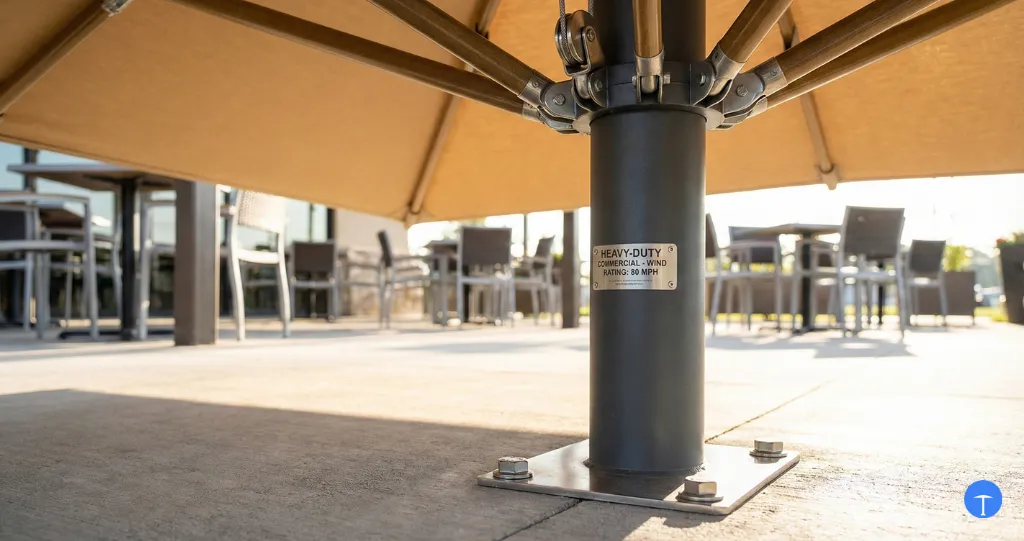
A genuinely commercial grade patio umbrella has a thick wall aluminum pole (1.5 inches or larger in diameter with 3mm plus wall thickness), fiberglass or heavy duty aluminum ribs, solution dyed acrylic canopy fabric rated for 1500 plus hours of UV exposure, a push up or pulley lift mechanism tested for 1500 plus cycles, marine grade stainless steel hardware, a wind rating of at least 50 mph, and a frame warranty of three years or longer.
The problem is that “commercial grade” is not a regulated term. No certification body governs its use, so you need to verify these heavy duty patio umbrella specifications yourself rather than trusting marketing labels.
No industry standard body certifies patio umbrellas as commercial grade. There is no testing protocol, no seal of approval, and no governing organization a manufacturer must satisfy before labeling a product “commercial.” Any company can use the term freely alongside “heavy duty,” “professional,” and “hospitality grade.”
This matters when you are ordering 20 umbrellas for a restaurant patio or hotel pool deck. Price does not help either. Some overpriced residential umbrellas cost more than genuine commercial models from direct manufacturers who specialize in hospitality furniture. The only reliable way to determine what qualifies as commercial grade umbrella construction is checking each component specification individually, which is what this article walks you through. For a broader side by side breakdown, our commercial vs residential umbrella comparison covers that angle.
The frame is the structural foundation of every commercial grade patio umbrella, and checking the pole specs on a product listing is the fastest way to separate genuine commercial grade patio umbrella specs from residential products with inflated marketing.
Commercial umbrella pole diameter starts at 1.5 inches. Anything under that is residential. Premium commercial models use 2 to 2.5 inch poles that support larger canopies and handle sustained wind loads.
Commercial umbrella frame thickness requires a 3mm wall minimum. Premium poles run 3.5 to 4mm. A 1.5 inch pole with thin 1.5mm walls will flex and fail under daily commercial use. If a product listing does not specify wall thickness, treat that as a red flag.
Aluminum is the standard for commercial frames: lightweight, rust proof, and strong. Steel is heavier and rusts. Hardwood like teak or ash appears in premium settings but demands more maintenance.
Anodized aluminum or powder coated finishes provide the best corrosion resistance for commercial environments. Painted finishes chip and degrade faster, especially in coastal or humid locations. If a listing says “coated” without specifying anodized or powder coat, assume a basic paint job.
One piece poles deliver maximum strength and suit permanent commercial installations. Two piece poles with threaded couplings are acceptable. Two piece poles with push button couplings are residential. The push button connection creates a weak point that wobbles and fails under the stress of daily use and wind loading.
Fluted pole designs (ribbed profile rather than smooth) add structural rigidity and resist bending under wind stress. Understanding how all of these patio umbrella parts connect helps you evaluate build quality at a glance.
Fiberglass ribs flex under wind pressure without snapping or permanently bending, making them the preferred choice for high wind commercial applications. Heavy duty aluminum ribs are acceptable but can permanently deform in strong gusts.
Rib count matters: commercial umbrellas typically have 8 ribs, while budget residential models cut costs with 6. Hub and rib connections should use stainless steel rivets or bolts. Plastic connectors are a dead giveaway of residential construction regardless of marketing. Rib tips need reinforced end caps rather than exposed raw edges that snag and tear canopy fabric.
The canopy is where the biggest quality gap between commercial and residential umbrellas shows up. Fabric type, weight, and stitching each reveal whether an umbrella will survive daily outdoor commercial use or fade and fall apart within a season or two.
Solution dyed acrylic umbrella fabric is the gold standard for commercial use because the color is infused into the fiber during manufacturing, not applied as a surface coating. This makes it dramatically more fade resistant, water resistant, and easy to clean compared to alternatives.
Polyester is surface dyed and not commercial grade even when marketed that way. It fades noticeably within one to two seasons of daily outdoor exposure. Olefin sits in the mid range with good moisture resistance but lower UV durability than solution dyed acrylic. The Industrial Fabrics Association International publishes technical resources on performance fabric standards for deeper evaluation. For broader fabric education beyond commercial specifications, our guide to types of patio umbrellas covers the full range.
Commercial patio umbrella fabric weight runs 9 to 10 oz per square yard versus 5 to 7 oz for residential. The heavier weight delivers better shade density, wind resistance, and longevity.
Stitching reveals build quality fast. Commercial grade means double stitched seams with UV resistant thread. Residential models use single stitching with standard thread that degrades in sunlight. Look for reinforced stress points where the canopy attaches to the rib tips and around the hub area.
Look for UPF 50 plus, which blocks 98% of UV rays. Lower ratings indicate lighter weight residential fabric. The fade warranty tells you even more: 5 years is the commercial standard for solution dyed acrylic. Anything under 3 years signals residential quality regardless of the price tag.
Commercial umbrella mechanism durability is one of the easiest specifications to check and one of the most revealing. Push up lift is the simplest and most durable commercial mechanism. There are no moving parts to break. Staff push the canopy up the pole to a locking position, and that is the entire operation.
Pulley and pin systems use braided rope on two pulleys to lift heavier canopies. These are standard on larger commercial umbrellas where the canopy is too heavy for manual push up.
Crank lift is NOT commercial grade despite appearing on expensive residential models. Crank housings, gears, and handles have a 300 to 500 cycle lifespan versus 1500 plus for push up and pulley systems. Cranks also create a safety and liability risk in public settings where customers unfamiliar with the mechanism can damage it or cause the canopy to collapse unexpectedly. Auto tilt is a residential convenience feature that adds mechanical complexity and failure points not suitable for commercial environments.
The cycle rating to look for is 1500 plus open and close cycles. If the manufacturer does not publish a cycle rating, ask for it. If they cannot provide one, that tells you enough. For wind exposed locations where choosing the best patio umbrella for windy areas matters, mechanism simplicity becomes even more critical.
Every bolt, screw, hinge pin, and connector should be 316 marine grade stainless steel. Standard zinc plated hardware rusts within months in coastal or humid conditions. Check the hinge pins, rib connectors, and base mounting hardware specifically. Spring loaded locking pins should be stainless steel with corrosion resistant springs.
A vented canopy is a defining commercial feature. The opening at the crown allows wind to pass through rather than catching the canopy like a sail. This single design element dramatically reduces wind force on the frame and base.
The commercial umbrella wind rating minimum is 50 mph. Premium commercial models rate to 65 or 85 mph. Many residential umbrellas publish no wind rating at all, which is a clear indicator of residential construction. Organizations like ASTM International develop testing standards for outdoor structural products, though no specific certification exists for patio umbrella wind ratings. True wind resistance comes from the integrated system of vented canopy, fiberglass ribs, and properly anchored base working together.
Commercial bases weigh 75 to 150 pounds for freestanding use versus 30 to 60 pounds for residential. A residential base cannot counterbalance the wind load on a commercial sized canopy. The general rule is 10 pounds of base weight per foot of canopy diameter. Our patio umbrella size chart helps match base weight to canopy dimensions.
In ground sleeve mounts and bolt down surface plates are the safest commercial option. They eliminate tip over risk and keep floor space clear of trip hazards.
The commercial umbrella warranty is one of the most reliable indicators of actual build quality. Genuine commercial grade carries a 3 to 5 year frame warranty and a 5 year fade warranty on canopy fabric. Commercial warranties should explicitly state that coverage applies to commercial use settings.
Read the fine print on any umbrella you are considering. Many residential warranties explicitly void coverage if the product is used in a commercial setting. If you put one of these on your restaurant patio, you have zero warranty protection from day one.
Replacement parts availability is another tell. Genuine commercial manufacturers sell individual canopies, ribs, hubs, and mechanisms. If replacement parts are not available, the umbrella is designed as a disposable product regardless of its marketing. A solid commercial umbrella maintenance routine depends on being able to swap worn components rather than replacing the entire unit.
| Component | Commercial Grade Minimum | Premium Commercial | Residential Typical | Red Flag |
|---|---|---|---|---|
| Pole Diameter | 1.5 inches | 2 to 2.5 inches | 1.25 to 1.5 inches | Under 1.5 inches |
| Pole Wall Thickness | 3mm | 3.5 to 4mm | 1.5 to 2mm | Under 2.5mm |
| Pole Coupling | Threaded two piece | One piece solid | Push button two piece | Push button |
| Rib Material | Heavy duty aluminum | Fiberglass | Thin aluminum | Plastic connectors |
| Rib Count | 8 ribs | 8 to 10 ribs | 6 to 8 ribs | Under 6 ribs |
| Canopy Fabric | Solution dyed acrylic | Marine grade solution dyed acrylic | Polyester or olefin | Polyester labeled commercial |
| Fabric Weight | 9 oz per sq yard | 9.5 to 10 oz per sq yard | 5 to 7 oz per sq yard | Under 7 oz |
| UV Rating | UPF 50 | UPF 50 plus | UPF 15 to 30 | No UPF rating listed |
| Lift Mechanism | Push up or pulley | Push up or pulley | Crank lift | Crank only with no cycle rating |
| Mechanism Cycle Rating | 1500 plus cycles | 2000 plus cycles | 300 to 500 cycles | Not published |
| Wind Rating | 50 mph | 65 to 85 mph | 25 to 35 mph | No rating published |
| Canopy Vent | Yes | Yes | Rarely | No vent on 9 foot plus canopy |
| Hardware | Stainless steel | 316 marine grade stainless | Zinc plated | Plastic or unspecified |
| Frame Warranty | 3 years | 5 years | 1 year | Under 1 year or voids commercial use |
| Fabric Warranty | 5 years fade | 5 years fade | 1 to 2 years | No fade warranty |
| Replacement Parts | Available | Full catalog available | Rarely available | None available |
If you spot any of these on a product listing, you are looking at a residential umbrella regardless of marketing:
Two or more of these means the umbrella is residential and you should keep looking.
No. There is no industry certification body or regulated standard that defines “commercial grade” for patio umbrellas. Any manufacturer can use the term in marketing, which is why you need to check individual specifications like pole diameter, fabric type, wind rating, and warranty terms rather than trusting the label.
Solution dyed acrylic is the industry standard because the color is built into the fiber during manufacturing rather than applied as a surface coating. This makes it dramatically more resistant to fading, water, mold, and staining compared to polyester or olefin, and most solution dyed acrylic canopies carry a 5 year fade warranty.
Push up and pulley lift mechanisms have no gears, housings, or handles to break, giving them a cycle life of 1500 plus openings compared to 300 to 500 for crank systems. Cranks also present a liability risk in commercial settings because customers and guests unfamiliar with the mechanism can damage it or cause the canopy to collapse unexpectedly.
Check five things: pole diameter (1.5 inches or larger), canopy fabric type (solution dyed acrylic, not polyester), wind rating (50 mph or higher), lift mechanism type (push up or pulley, not crank), and warranty terms (3 plus years on frame, 5 years on fabric that explicitly covers commercial use). If any of these fall short, the umbrella is residential regardless of its marketing.
Yes. Commercial umbrellas require heavier bases (75 to 150 pounds for freestanding use) or permanent mounting solutions like in ground sleeves or bolt down surface plates. Using a commercial umbrella with a lightweight residential base creates a serious safety hazard because the larger canopy catches more wind force than a residential base can counterbalance.
“Commercial grade” is a marketing phrase, not a specification. The only way to verify whether an umbrella will handle daily commercial use is checking the components: 1.5 inch plus aluminum pole with 3mm walls, solution dyed acrylic fabric at 9 oz or heavier, push up or pulley mechanism rated for 1500 plus cycles, 316 stainless steel hardware, a vented canopy with a 50 mph or higher wind rating, and a warranty that explicitly covers commercial use for three years or longer.
If a manufacturer will not publish these numbers, they are counting on you buying based on marketing alone. Start with our best commercial patio umbrellas guide to find models that actually meet these standards.