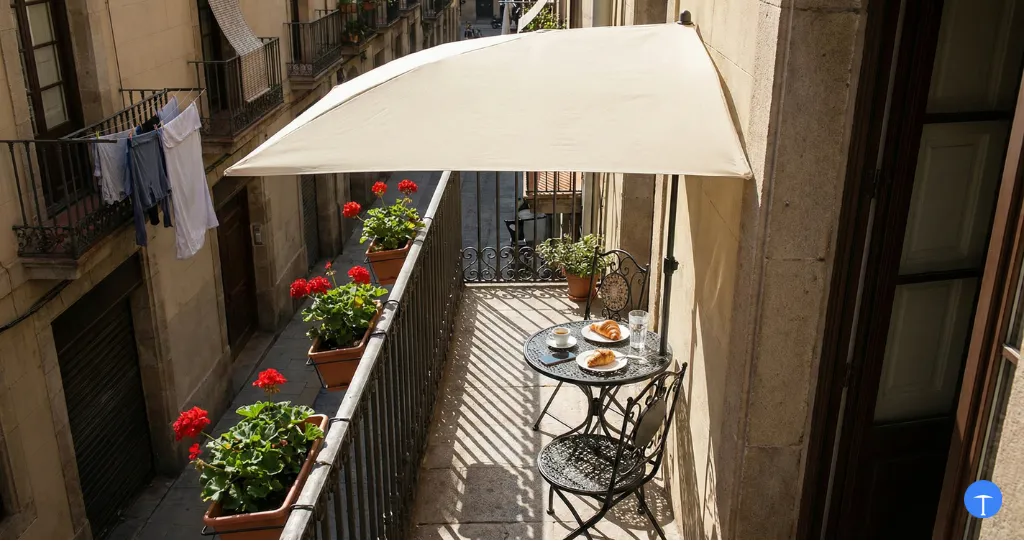
The best patio umbrella for a small balcony is typically a half umbrella or compact 6 foot market umbrella with a slim base. These options provide adequate shade while taking up minimal floor space, and most work without permanent mounting that landlords prohibit.
This guide covers which umbrella styles work in compact spaces, what sizes fit common balcony dimensions, and how to mount an umbrella when drilling is not an option.
Most balconies under 50 square feet face three major obstacles: limited floor space for umbrella bases, overhead clearance restrictions from the unit above, and landlord rules against permanent mounting.
Floor space is the biggest constraint. A typical umbrella base needs 18 to 24 inches of clearance in every direction, which can consume a quarter of a small balcony. Add a chair and small table, and there is no room to move.
Overhead clearance matters more than most people realize. If you have neighbors above, their balcony floor sits roughly 9 to 10 feet above yours. A fully opened 9 foot umbrella on a standard pole reaches 8 feet at minimum, leaving almost no gap.
Renter Alert: Most leases prohibit drilling into walls, railings, or balcony ceilings. Any umbrella solution needs to be temporary and removable. Check your lease before installing wall mounted options.
Half umbrellas, compact market umbrellas in the 6 to 7 foot range, and rail mounted options work best for small balconies. Each solves different space problems, and the right choice depends on your specific layout and how you use the space.
| Umbrella Type | Footprint | Coverage Area | Best For | Mounting Type |
|---|---|---|---|---|
| Half Umbrella | 12” x 18” base | 35-40 sq ft | Against walls or railings | Weighted base |
| 6ft Market Umbrella | 18” round base | 28 sq ft | Center table placement | Through table hole or weighted base |
| 7ft Market Umbrella | 20” round base | 38 sq ft | Larger bistro setups | Through table hole or weighted base |
| Rail Mount Umbrella | 0 sq ft (clamps to rail) | 30-40 sq ft | Maximizing floor space | Clamp mount |
| Wall Mount Umbrella | 0 sq ft (wall bracket) | 35-50 sq ft | Permanent installations | Screw mount |
| Table Umbrella (bistro) | 0 sq ft (uses table) | 20-30 sq ft | Small dining setups | Through table hole |
Half umbrellas feature a flattened back edge designed to sit flush against a wall or railing. The canopy extends outward in a semicircle rather than a full circle, providing shade where you need it without wasting coverage behind the pole.
A half umbrella with a 9 foot diameter provides roughly the same forward shade as a full 7 foot round umbrella, but the base can sit against your wall instead of in the middle of your space. You gain 12 to 18 inches of usable floor area compared to a centered umbrella.
The tradeoff is flexibility. Half umbrellas only work in one orientation. If the sun moves behind your building in the afternoon, the umbrella cannot rotate to track it.
Standard market umbrellas scaled down to 6 or 7 foot diameters fit small balconies when centered through a bistro table. At this size, the opened canopy stays within most balcony footprints while still providing useful shade.
A 6 foot umbrella covers approximately 28 square feet when fully open, enough to shade a small bistro table and two chairs. The smaller canopy also catches less wind, reducing the risk of tipping.
The 7 foot size works for slightly larger balconies or when you want to shade a single lounge chair. The extra foot of diameter adds 10 square feet of coverage.
Rail mounted umbrellas clamp directly to your balcony railing, eliminating floor space requirements entirely. The umbrella pole attaches to a heavy duty clamp that tightens onto railings up to 2 inches thick.
This mounting style works best with square or rectangular railings. Round railings can work but tend to allow more rotation and wobble.
Wall mounted umbrellas require drilling, which limits them to homeowners. The fixed bracket means the umbrella stays in one position, but folding designs allow the canopy to be stowed against the wall when not in use.
Best for Renters: Rail mounts are renter friendly since they leave no marks and remove in seconds. No tools required beyond initial setup.
If you already have a bistro table with an umbrella hole, using that hole eliminates the base problem entirely. The table provides all the support, and the umbrella simply drops through.
Standard umbrella holes are 1.5 to 2 inches in diameter. Most umbrella poles fit these dimensions, though you should measure before buying.
Bistro table umbrellas typically max out around 6 feet since larger canopies create too much leverage on the small table.
Match your umbrella size to your balcony dimensions by leaving at least 12 inches of clearance between the opened canopy edge and any wall or railing. This prevents fabric damage and allows the umbrella to move slightly in wind.
A 4 by 6 foot balcony fits a 6 foot umbrella maximum when mounted at center or a half umbrella up to 7.5 feet when placed against the long wall. A 5 by 8 foot balcony accommodates up to 7 foot round umbrellas or 9 foot half umbrellas.
Consider round versus square umbrella shapes based on your balcony configuration. Square umbrellas often fit rectangular balconies more efficiently.
Weighted bases designed for small spaces use dense materials in compact footprints. Look for bases under 18 inches in diameter that weigh at least 30 pounds for 6 foot umbrellas or 40 pounds for 7 foot umbrellas.
Cast iron bases offer the best weight to size ratio. A cast iron base weighing 40 pounds might measure just 14 inches in diameter, while a plastic fillable base of equal weight spreads across 20 or more inches. Most apartment balconies can safely hold 40 to 100 pounds per square foot, so even heavy bases pose no structural concern.
Corner placement bases with asymmetric shapes let you tuck the weight into unused corners. Some bases feature triangular footprints specifically for corner installation.
Pro Tip: If floor space is extremely limited, eliminate the standalone base entirely. Table mounted systems, rail clamps, and wall brackets keep the floor completely clear for furniture and movement.
Renters need mounting solutions that leave no marks and require no tools beyond basic tightening. Weighted bases, rail clamps, and freestanding bracket systems all meet this requirement.
The most versatile renter option is a heavy weighted base with a universal pole receiver. This works on any flat surface and holds poles from 1.25 to 1.75 inches in diameter. When you move, the base comes with you.
Rail clamps install and remove in under a minute. Quality clamps can hold umbrellas up to 7 feet in moderate wind without damaging the railing finish. The Beaufort wind scale classifies moderate wind as 13 to 18 mph, which most rail clamps handle reliably.
Tilt mechanisms let you angle the canopy to follow the sun, effectively increasing coverage without increasing umbrella size. On small balconies where oversized umbrellas do not fit, tilt becomes essential for all day shade.
Push button tilt provides the simplest adjustment. Pressing a button on the pole releases the canopy to tilt in one direction. Crank tilt combines opening and tilting in one mechanism with more angle range. Collar tilt provides the most flexibility.
For help understanding how umbrella tilt mechanisms work to extend coverage, check our detailed guide.
For balconies exposed to strong winds, understand how tilt interacts with wind resistance. Tilted umbrellas catch wind differently than vertical ones.
Umbrella height matters when your upstairs neighbors have a balcony directly above. Measure from your floor to their balcony underside before selecting any umbrella.
Standard umbrella poles extend 7.5 to 8 feet when fully raised with the canopy open. Add 1 to 2 feet for the canopy peak, and total height reaches 9 to 10 feet. If your neighbor’s balcony floor is under 10 feet above yours, standard umbrellas risk contact in wind.
Low Clearance Solution: Shorter pole umbrellas exist for exactly this situation. Look for umbrellas marketed for covered patios or low clearance applications, which typically max out at 6 to 7 feet total height.
Before shopping, measure your balcony floor dimensions, vertical clearance, railing dimensions if using clamp mounts, and any umbrella hole in existing furniture.
Floor dimensions should be measured at the widest and narrowest points since many balconies are not perfect rectangles. Note any fixed features that reduce usable space.
Vertical clearance means the height from floor to any overhead obstruction. Include the underside of upstairs balconies, awning structures, or building overhangs.
For rail mounting, measure railing width and thickness. Most rail clamps specify maximum dimensions around 2 inches thick by 4 inches wide.
Understanding the parts of a patio umbrella helps you evaluate which components affect fit on your specific balcony.
Cantilever umbrellas rarely work on small balconies. The offset base requires 4 to 5 feet of floor space just for the support arm, and the smallest cantilever canopies start around 8 feet. You would end up with most of your balcony consumed by the base mechanism while the canopy extends over your neighbor’s space.
The smallest standard patio umbrellas measure 4 to 5 feet in diameter. Beach umbrellas can go smaller, and the compact options for beach use sometimes work on balconies. For true patio umbrellas with tilt mechanisms and table compatibility, 6 feet is the practical minimum.
Half umbrellas provide adequate shade for one to two people when positioned correctly. A 9 foot half umbrella covers roughly 35 square feet, enough for two chairs and a small table. The key is placement directly behind your seating rather than off to the side.
Yes, rail clamp mounts support umbrellas up to 7 feet on most standard railings. Check your lease first since some landlords consider clamp mounts modifications even though they leave no marks. The railing must be sturdy enough to handle wind loads, so avoid mounting to decorative or aging railings.
A 6 foot market umbrella or 7 foot half umbrella fits a 4 by 6 balcony comfortably. The market umbrella works best mounted through a bistro table at center, while the half umbrella should go against the 6 foot wall. Either option leaves room for two chairs and a small table.
For most small balconies, start with a 6 foot market umbrella through a bistro table. This setup costs less than alternatives, leaves floor space open, and provides the easiest setup and removal.
If you have a wall or railing to work with and want maximum coverage, upgrade to a 7 to 9 foot half umbrella. The flat back design maximizes shade per square foot of floor space.
Rail clamp systems make sense when you cannot sacrifice any floor space but have sturdy railings. These offer the best clearance for movement on tiny balconies.
Whatever you choose, prioritize tilt capability over size. A smaller umbrella with good tilt adjustment provides more usable shade throughout the day than a larger fixed umbrella that only works for a few hours.
Consider fabric quality carefully since small balcony umbrellas sit closer to seating areas where you notice color fade and wear more easily.