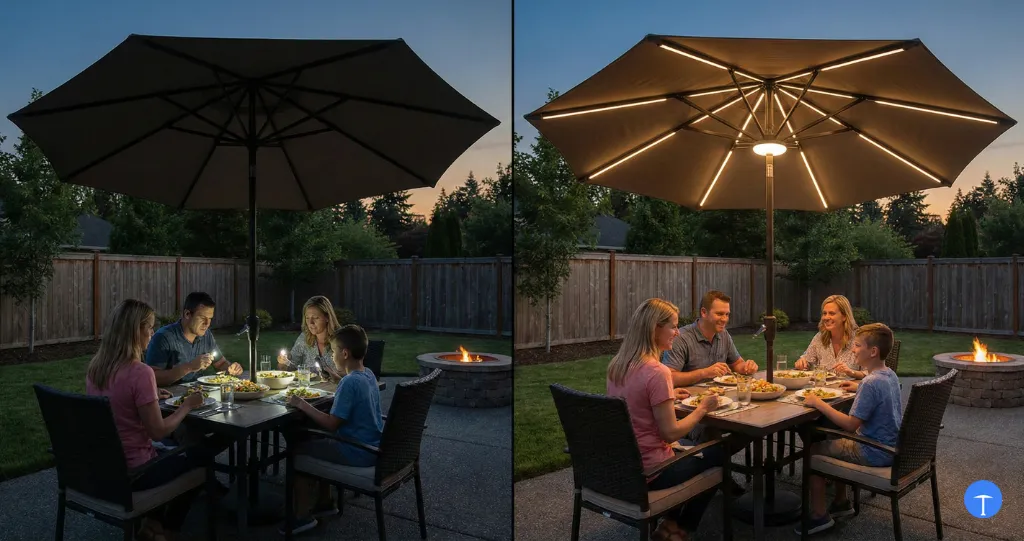
Are LED umbrellas worth it? For the right buyer, yes. If you value a clean, integrated look and stick with a mid-range or premium model, a patio umbrella with lights built in delivers real convenience. One product handles both shade and evening ambiance without cords, clips, or extra batteries.
But here is the honest part most reviews skip: budget LED umbrellas are almost never worth it. The lights are dim, the batteries fade fast, and when something fails you are usually stuck replacing the whole thing. For many people, buying a quality standard umbrella and adding aftermarket patio umbrella lights separately is the smarter move with better brightness, more flexibility, and easier replacement.
LED patio umbrellas span a wide price range, and what you get at each tier is dramatically different. Any LED umbrella worth it starts at the mid-range tier or above.
In the $60 to $120 range, expect 24 to 32 LEDs, thinner canopy fabrics, and lighter frames. Run time is typically 4 to 6 hours per charge, and the actual LED umbrella brightness on these models is barely noticeable once the sun fully sets. These account for most negative reviews online.
The $120 to $250 range is where LED umbrellas start making a genuine case for themselves. Expect 32 to 48 LEDs, run times of 6 to 10 hours, improved canopy materials, and solar panels paired with rechargeable batteries that hold up for a couple of seasons. When you weigh the solar LED umbrella pros and cons at this tier, the convenience starts outweighing the trade-offs.
Above $250, you are looking at higher LED counts, Sunbrella or equivalent fade-resistant fabrics, commercial-grade frames, and longer warranties. Some premium models include USB charging ports built into the pole. These are the models that last multiple seasons without complaints about dim lighting or short battery life. To understand more about how much patio umbrellas cost across all categories, that guide covers the full landscape.
| Price Tier | Typical Price Range | LED Count | Expected Run Time | Canopy Quality | Frame Quality | Worth It? |
|---|---|---|---|---|---|---|
| Budget | $60 to $120 | 24 to 32 | 4 to 6 hours | Thin polyester | Lightweight steel | Rarely |
| Mid-Range | $120 to $250 | 32 to 48 | 6 to 10 hours | Durable polyester or olefin | Powder-coated steel or aluminum | Yes, for most buyers |
| Premium | $250+ | 48+ | 8 to 12 hours | Sunbrella or equivalent | Commercial-grade aluminum or fiberglass | Yes, if budget allows |
This is the strongest argument for built-in umbrella lights, and it is legitimate. When the LEDs are wired into the ribs and powered by a solar panel or battery compartment, you get a seamless experience. No separate lights to buy, hang, or maintain. No cords running down the pole. No clips or zip ties holding string lights to the ribs. You open the umbrella, the sun charges the panel during the day, and the lights turn on at dusk.
For people who entertain regularly or want their patio to look polished without fussing over accessories, that convenience carries real value. It is the same reason people pay more for a market umbrella with a built-in tilt mechanism instead of manually adjusting a basic model.
No honest LED patio umbrella review skips this section. The convenience is real, but solar umbrella durability and performance issues are equally real.
Most built-in LED umbrellas produce ambient mood lighting, not functional task lighting, with total output of 50 to 150 lumens spread across all the LEDs. That is fine for casual conversation but not enough to read, play cards, or see your food clearly. According to The Home Depot’s outdoor lighting guide, patios typically need 300 to 500 lumens for functional use, and a single aftermarket pole clamp light delivers 200 to 400 lumens.
LED umbrella battery life is one of the most common complaints among owners. Rechargeable batteries lose capacity over time, and after two to three seasons of regular use you will notice shorter run times. Many manufacturers use proprietary battery packs that are difficult or impossible to find as replacements, so when the battery dies, the LED feature effectively dies with it.
When an LED strip fails or wiring breaks along a rib, you typically cannot repair it. The wiring is integrated into the structure, and manufacturers do not sell replacement components. Your options are to live with partial lighting or replace the whole umbrella.
The solar panels on LED umbrellas are small, typically 1 to 3 watts, and need 6 to 8 hours of direct sunlight for a full charge. If your patio is partially shaded or you live somewhere with frequent cloud cover, you may never get a full charge. The U.S. Department of Energy notes that solar panels generally degrade at 0.5% to 1% per year, and the small panels on umbrella canopies degrade faster due to constant UV exposure and weather cycling. The guide on whether solar umbrellas charge on cloudy days covers performance in less-than-ideal conditions, and the solar umbrella technology guide explains the mechanics.
This comparison helps clarify which approach fits your situation, whether you are debating LED umbrella vs string lights, pole clamp options, or Edison bulb sets. Neither option is universally better.
| Factor | Built-In LED Umbrella | Standard Umbrella + Aftermarket Lights |
|---|---|---|
| Upfront Cost (Budget) | $60 to $120 | $80 to $140 total |
| Upfront Cost (Mid-Range) | $120 to $250 | $120 to $240 total |
| Typical Brightness (Lumens) | 50 to 150 total | 200 to 400+ per light unit |
| Run Time Per Charge | 6 to 12 hours (solar), 8 to 15 hours (battery) | Varies by light type, typically 8 to 20+ hours |
| Setup Convenience | Excellent, one-piece setup | Moderate, requires separate installation |
| Aesthetics | Clean, integrated, no visible accessories | Varies, some setups look DIY |
| Repairability | Poor, usually cannot repair LEDs | Good, replace individual lights easily |
| Upgrade Flexibility | None, locked into built-in system | High, swap lights anytime |
| Replacement Cost When Lights Fail | Full umbrella replacement ($60 to $250+) | New light only ($15 to $40) |
| Best For | Ambiance seekers who value clean looks | Brightness-focused users who want flexibility |
An LED umbrella is worth the investment when you value a clean, integrated look with nothing extra clipped or dangling from the ribs. You use your umbrella primarily for evening ambiance, not activities requiring strong task lighting. You are willing to spend mid-range or above, because budget models are where most disappointment comes from. The solar patio umbrella value proposition gets stronger the more evenings you spend outside.
Your location gets reliable direct sunlight, and portability matters. If you are shopping for a windy location, the guide on umbrellas for windy areas covers what to look for.
Separate lights make more sense when you already own a quality umbrella, you need brighter lighting for dining or games, or you want the ability to replace lights independently. They also win when budget is a primary concern or your umbrella sits under a covered patio where solar charging would be unreliable.
For guidance on options and how to install lights on a patio umbrella properly, those companion guides walk through the process.
The LEDs themselves are rated for 20,000 to 50,000 hours, so the bulbs are not the weak link. The real limiting factors are the battery and wiring, with rechargeable batteries degrading noticeably after 2 to 3 seasons and wiring along the ribs breaking from repeated opening, closing, and weather exposure within 1 to 3 years depending on build quality.
In most cases, no. The LED strips and wiring are integrated into the umbrella frame during manufacturing, and manufacturers rarely sell replacement parts. If the lights fail, you are generally left using it as a standard umbrella or replacing the entire unit.
Not typically. Brightness depends on LED count and quality, not the power source. Battery-powered models using standard AA or rechargeable lithium batteries often deliver more consistent run times because they are not dependent on daily sun exposure.
For casual dining where ambiance matters more than visibility, most mid-range and premium LED umbrellas work fine. For meals where you want to clearly see your plate or read a menu, the 50 to 150 lumens that most LED umbrellas produce will feel insufficient, and a dedicated aftermarket pole light with 200 to 400 lumens is a better fit.
Adding lights to a regular umbrella is almost always cheaper at equivalent quality levels. A solid standard umbrella ($80 to $200) plus quality aftermarket lights ($15 to $40) gives you a combined product for $95 to $240 that typically delivers brighter light and independent replaceability. For a full breakdown of umbrella pricing across all types, that guide covers the details.
The question of whether any specific LED umbrella is worth it comes down to tier and use case. If you value the clean integrated look, use outdoor lighting primarily for ambiance, and invest in a mid-range or premium model, the convenience is genuinely appealing.
For everyone else, buying a quality standard umbrella and adding aftermarket lights that match your brightness needs is the smarter play. You will spend less, get brighter light, and have flexibility to upgrade independently. Either way, skip the budget LED umbrellas.
Browse the full roundup of top-rated LED patio umbrellas to compare specific models, or visit the PatioUmbrellaHub homepage to explore guides based on size, type, and use case.