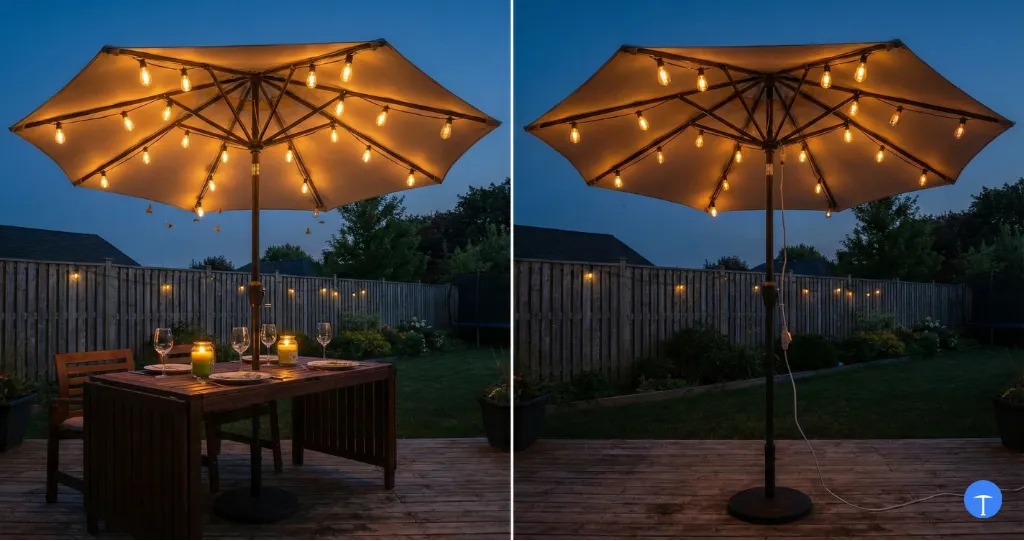
The best patio umbrella lights come down to three things: whether you want ambiance or usable task lighting, which power source fits your setup, and what type of umbrella you have. Pole clamp lights deliver the most focused brightness for dining and activities. String lights create the best atmosphere for relaxed evenings. And solar powered options offer the most convenience if your umbrella gets consistent direct sunlight during the day.
Getting this right saves you from buying outdoor umbrella lighting that barely illuminates your table or kills the mood by being too bright. Below is everything organized by light type first, then by power source.
Brightness matters more than most people expect. A string of decorative umbrella rib lights looks beautiful but won’t help you see what you’re eating. On the other end, an umbrella pole light pumping out 400 lumens feels like a spotlight if all you wanted was a warm glow.
Your umbrella design matters too. A center pole umbrella works with every light type on the market. An offset or cantilever umbrella is a different story since the pole sits off to the side, which limits where light falls. Power source is the other big decision. Solar sounds great until you realize your umbrella sits under a covered pergola.
Each umbrella light type serves a different purpose. Some are built for functionality, others are purely decorative, and a few land somewhere in between. Here is how they stack up.
| Light Type | Brightness (Lumens) | Best For | Installation Difficulty | Works With Offset Umbrellas | Price Range |
|---|---|---|---|---|---|
| Pole Clamp Light | 200 to 400 | Dining, reading, card games | Easy | Yes (check pole diameter) | $15 to $35 |
| String Lights (Rib Mounted) | 80 to 150 total | Ambiance, decorative glow | Moderate | Yes | $12 to $30 |
| Clip-On Canopy Lights | 30 to 80 | Accent lighting, supplemental | Very Easy | Yes | $8 to $20 |
| Edison Bulb Hanging Lights | 150 to 300 | Vintage aesthetic, entertaining | Moderate to Difficult | Yes | $20 to $50 |
| Pole Mounted Candle Holder | Minimal (candlelight) | Decorative only | Easy | Limited | $10 to $25 |
A pole clamp umbrella light attaches directly to the umbrella pole using an adjustable clamp or bracket. It sits near the top and aims light downward onto the table. Most models pack 28 to 48 LEDs and put out 200 to 400 lumens of focused light. This is the best type if you need umbrella lights for outdoor dining, card games, or reading.
Many models come with adjustable brightness so you can dial it up for activities or turn it down after dinner. Check pole diameter compatibility before buying. Most clamp lights fit standard center poles, but thicker commercial poles or cantilever umbrella arms may need a wider clamp. Some models include a hook for hanging from the umbrella hub, which works better for offset setups.
Umbrella string lights run individual LED strands along each rib of the canopy. A typical set has 8 strands with 10 to 15 LEDs per strand, giving you 80 to 120 total LEDs spread across the underside. The per LED brightness is low, but the wide distribution creates an even, warm glow.
These are the go-to choice for ambiance. They attach with zip ties, small clips, or adhesive strips, and they come in warm white, cool white, multicolor, and color changing options. Many sets include lighting modes like steady, twinkle, fade, and flash. The tradeoff is that string lights alone will not give you enough umbrella light lumens for tasks. They create atmosphere, not work light. For attachment details, the umbrella light installation guide covers the process.
A clip-on umbrella light is a small LED unit that clips to the rib tips or along the rib edges. These are the easiest to install and remove since you literally clip them on when you want them and take them off when you don’t. Brightness per unit is on the lower end, so they work best as supplemental lighting or accent pieces alongside a primary source like a pole clamp.
Edison bulb style hanging lights for patio umbrellas bring a vintage or industrial aesthetic. These decorative bulb strings hang from the ribs and produce noticeably more light than standard string lights thanks to larger bulbs. The main thing to know is weight. On a sturdy market umbrella they work fine, but on lighter frames the extra weight can affect the tilt mechanism or stress the ribs.
These attach to the umbrella pole and hold real candles, battery candles, or small lanterns. No electrical components, nothing to charge, and nothing that can malfunction. Light output is minimal and purely decorative, but they pair well with string lights if you want a layered look.
The power source you choose affects where you can use your lights, how much ongoing maintenance they need, and how reliable they are night to night.
| Power Source | Run Time | Ongoing Cost | Reliability | Best Location | Convenience |
|---|---|---|---|---|---|
| Solar | 6 to 10 hours (full charge) | None | Variable (sun dependent) | Open sun areas | High (no cords, no batteries) |
| Battery (Disposable AA/AAA) | 20 to 40 hours | Battery replacement | Consistent | Anywhere | Moderate |
| Battery (Rechargeable USB) | 8 to 15 hours | Electricity (minimal) | Consistent | Anywhere | Moderate (requires charging) |
| Plug-In Electric | Unlimited | Electricity (minimal) | Very High | Near outdoor outlets | Low (cord management) |
Solar umbrella lights come with a small solar panel that clips to the top of the umbrella or sits on the table. After 6 to 8 hours of direct sunlight, you get a full charge that runs the lights through the evening. Free energy, no batteries, no cords.
The catch is that “direct sunlight” part. If your umbrella sits in an open area with consistent sun, solar works beautifully. If your patio is covered or surrounded by tall trees, performance drops significantly. The article on whether solar umbrellas charge on cloudy days breaks down what to expect in less than ideal conditions.
Any umbrella light battery operated with standard AA or AAA batteries works anywhere regardless of sun. You get 20 to 40 hours of run time per set depending on LED count, and swapping in fresh ones takes less than a minute. The ongoing cost of replacements adds up with frequent use, but for occasional evenings they are practical and reliable every time.
Rechargeable umbrella lights charge via a standard USB cable from any power source. You get 8 to 15 hours per charge with no ongoing battery costs and no cord during use. The only downside is remembering to charge them between gatherings. Plugging them in when you come inside makes it a non issue.
Plug-in umbrella lights connect to a standard outdoor rated extension cord and outlet. They are the brightest option, they run indefinitely, and output never fades as a battery drains. Cord management is the main drawback. Best for permanent patio setups where an outlet is nearby and you can route the cord cleanly.
What you plan to do under your umbrella narrows the choice more than anything else. Here is a quick match for the most common scenarios.
Casual evening ambiance → String lights (warm white, low brightness)
Dining and entertaining → Pole clamp light (200+ lumens, adjustable brightness)
Card games and reading → Pole clamp light at highest setting or a plug-in option
Pool or hot tub area → Waterproof umbrella lights, specifically solar string lights with an IP rating (no cords near water)
Large gatherings or parties → Combination of string lights plus a pole clamp light
If your evenings shift from dinner to conversation to games, combining string lights with an adjustable pole clamp gives you the most flexibility.
Not every light type works equally well with every umbrella style. Your umbrella’s design determines what mounts easily and what actually lights up the area where people sit.
Center pole umbrellas are the most versatile for lighting. Every type works because the pole runs directly above your table. Pole clamp lights are the easiest install. String lights, clip-on lights, and Edison bulb strings all attach to the ribs without compatibility issues.
Offset and cantilever umbrellas need more thought. The pole sits off to the side, so a pole clamp light may not illuminate your seating area at all.
Rib mounted string lights and clip-on canopy lights work better because they attach to the canopy itself, which hangs over the table regardless of pole position. Some pole clamp models include hooks for the central hub instead. For more on solar panel placement on these designs, see the solar umbrella technology guide.
Umbrella size affects both type and quantity. A 7 to 8 foot umbrella usually needs one pole clamp light or one set of string lights. Avoid heavy Edison bulb strings on smaller frames.
For umbrellas 11 feet and larger, one light set may not cover the canopy. You might need two sets of string lights or a brighter pole clamp. If you are unsure of your dimensions, the patio umbrella size chart can help.
Pole clamp lights are the brightest aftermarket option, typically producing 200 to 400 lumens of focused downward light. Plug-in electric models at the upper end of that range deliver the strongest output. If you want brightness from built-in LEDs instead, the comparison of whether LED umbrellas are worth it covers that alternative.
Yes. Solar string lights and solar clip-on lights mount to the canopy ribs rather than the pole, so they work well with offset designs. Solar pole clamp lights also work, but the light may miss your seating area since the pole is off to the side. Look for models with a hanging hook for the canopy hub.
For ambiance, 50 to 100 lumens spread across the canopy is plenty. For dining and entertaining, 200 lumens or more from a focused source like a pole clamp light gives you enough visibility to eat and socialize comfortably. Card games and reading benefit from 300 lumens or higher.
You can, but purpose-built umbrella string lights are a better choice. Regular string lights are designed for straight runs along fences or rooflines and do not follow the rib pattern of an umbrella canopy easily. Umbrella-specific sets have strands that radiate from a central point and attach to individual ribs for even coverage.
It depends on your setup. Solar lights are more convenient if your umbrella gets 6 to 8 hours of direct sunlight daily since there is nothing to charge or replace. Battery-operated lights are more reliable in shaded or covered areas because they perform the same regardless of weather. A rechargeable USB umbrella light is a good middle ground that avoids ongoing battery costs without depending on sun exposure.
Choosing the best lights for patio umbrella setups comes down to how you actually use your outdoor space. If you host dinners, a pole clamp light with adjustable brightness covers you. If your patio is more about unwinding in the evening, warm white string lights along the ribs create the right feel without overdoing it.
Start with the activity, match it to a light type, then pick the power source that fits your patio’s conditions. And if you are still deciding between aftermarket lights and an umbrella with lighting already built in, the LED patio umbrella guide covers the full range of options so you can compare before committing.