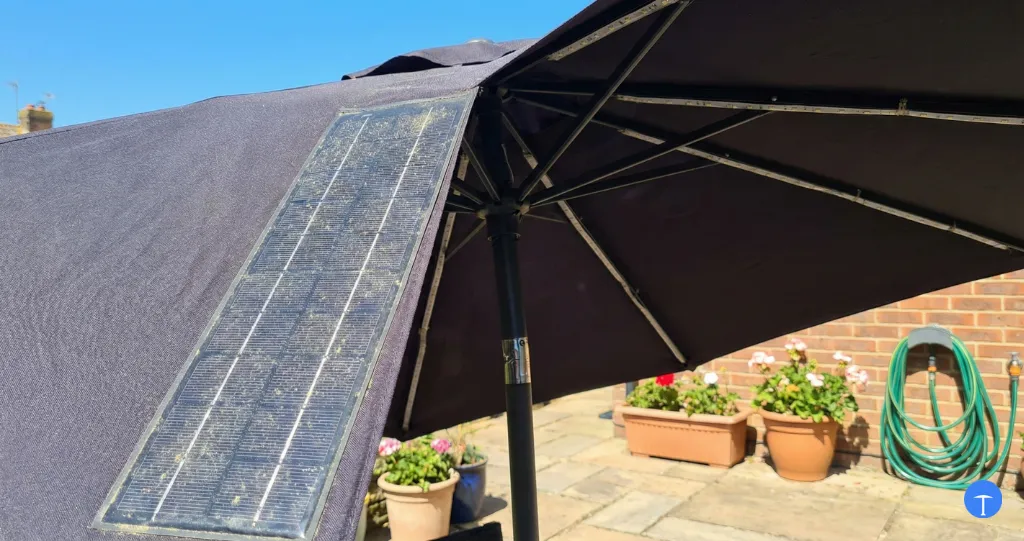
Solar patio umbrellas use a small solar panel mounted on the canopy top to convert sunlight into electricity. That electricity charges a built-in rechargeable battery stored inside the umbrella assembly. When evening rolls around and you flip the switch on the pole, the stored energy powers LED lights embedded along the umbrella ribs, giving you ambient lighting without any cords, outlets, or ongoing battery costs.
Most models need 6 to 8 hours of direct sunlight for a full charge and deliver 6 to 12 hours of light per charge cycle. The technology is straightforward, reliable, and has been refined over the past decade to the point where solar powered patio umbrella lights are now the default in most LED umbrella product listings. Whether you are looking at a basic market umbrella or a high-end cantilever, if it has built-in lights, odds are they run on solar. If you have ever browsed LED patio umbrellas and wondered how the lights actually work, the answer comes down to five core components working together.
Every solar umbrella relies on the same basic set of solar umbrella components, whether it is a compact model or a large cantilever. Understanding each one helps you evaluate quality when shopping and troubleshoot problems down the road.
The solar panel sits on top of the canopy, usually integrated into the finial (the decorative cap at the very top of the umbrella). Residential models typically use small monocrystalline or polycrystalline photovoltaic cells rated between 1 and 3 watts. These cells convert photons from sunlight into electrical current through the photovoltaic effect, the same process that powers rooftop solar installations, just at a much smaller scale.
Panel performance depends on a few practical factors: the angle of the panel relative to the sun, whether anything is casting shade on it, how clean the surface is, and the physical size of the panel itself. A dusty or partially shaded panel produces noticeably less power. If you are unfamiliar with the layout, a quick look at the parts of a patio umbrella shows you exactly where the finial and panel sit in relation to everything else.
The rechargeable battery stores the electrical energy the solar panel generates during the day. Most solar umbrella battery types are either NiMH (nickel metal hydride) or lithium ion, with capacities ranging from 1,500mAh on budget models to 6,000mAh on premium ones. A higher capacity NiMH umbrella battery or lithium ion pack means longer run time per charge.
Expect the battery to last 2 to 4 seasons before you notice meaningful capacity loss. Some manufacturers use standard replaceable AA NiMH batteries, which makes swapping them out easy and inexpensive. Others use sealed proprietary battery packs that are harder to replace. This is worth checking before you buy, and it is one of the factors that determines whether LED umbrellas are worth the investment long term.
LED lights are positioned along the umbrella ribs, typically with 3 to 5 individual LEDs per rib. Total LED counts vary by model: 24, 32, 40, and 48 are the most common configurations. Most LED solar umbrellas produce warm white light around 3000K, which gives off a soft, inviting glow similar to candlelight. Some models offer cool white (6000K) or color-changing options.
Solar umbrella LED brightness typically falls between 50 and 150 total lumens. That is ambient lighting, not task lighting. You will be able to see faces and food at the table, but you would not want to read a novel under it. The good news is that LEDs themselves last 25,000 to 50,000 hours, which means the rechargeable umbrella lights will far outlast the umbrella fabric, the battery, and probably the frame itself.
Thin gauge wires run from the solar panel down through the pole to the switch, then branch out along each rib to power the individual LEDs. The main connection point is at the hub where the ribs meet the pole. This wiring harness is actually the most common umbrella wiring failure point in solar umbrellas. Repeated opening and closing stresses the connections at the hub, and moisture exposure can corrode the thin wiring over time. When a solar umbrella stops working, the wiring is the first place to inspect.
Most solar patio umbrellas use a simple toggle or push-button switch mounted on the pole. Flip it on at dusk, flip it off when you head inside. Some models include brightness settings with low, medium, and high modes, and a few premium options offer remote controls or automatic dusk sensors that turn the lights on when ambient light drops below a certain threshold.
Solar Umbrella Component Reference
| Component | What It Does | What to Look For | Common Failure Points |
|---|---|---|---|
| Solar Panel | Converts sunlight into DC electricity via photovoltaic cells | Monocrystalline cells; 1 to 3 watt rating; clean, unobstructed mounting | Cracked cells; dirt and debris buildup; poor sun angle |
| Rechargeable Battery | Stores electrical energy for evening use | NiMH or lithium ion; 1,500 to 6,000mAh; replaceable preferred | Capacity loss after 2 to 4 seasons; sealed packs hard to replace |
| LED Lights | Provides ambient illumination along umbrella ribs | 24 to 48 LEDs; warm white 3000K; 50 to 150 lumens total | Individual LED burnout (rare); loose rib connections |
| Wiring Harness | Carries electricity from panel to battery to LEDs | Secure hub connections; weather-resistant insulation | Frayed wires at hub; corrosion from moisture exposure |
| Charge Controller | Regulates current flow from panel to battery to prevent overcharging | Built into solar panel unit on most models | Rarely fails independently; usually integrated into panel assembly |
| On/Off Switch | Controls power flow from battery to LEDs | Toggle or push button; brightness settings; dusk sensor on premium models | Water ingress; mechanical wear from repeated use |
| Hub Connector | Central junction where rib wiring meets pole wiring | Secure, weather-sealed connections at the hub | Loosened connections from opening and closing; primary failure point |
The solar umbrella charging cycle repeats daily and requires no intervention beyond flipping a switch. Here is what happens during each stage.
During the daytime, with the umbrella open and the canopy angled toward the sky, the solar panel absorbs sunlight and converts it into DC electricity. A small charge controller built into the panel unit regulates the current flow to prevent overcharging and directs electricity into the rechargeable battery. The battery stores this energy throughout the day, building up its charge gradually.
When evening arrives, you flip the switch on the pole. Stored battery power flows through the wiring harness, up through the hub connector, and out along each rib to the LED lights. The lights run until the battery is depleted or you turn them off manually. The next morning, the cycle begins again automatically as soon as sunlight hits the panel.
The entire process is passive during the day. You do not need to do anything except keep the umbrella open in sunlight. For a deeper look at how weather conditions affect this cycle, the guide on whether solar umbrellas charge on cloudy days covers the specifics.
A full solar umbrella charging cycle takes 6 to 8 hours of direct sunlight. Manufacturers recommend a full 8-hour initial charge before first use to condition the battery. After that, the panel needs to face upward toward the sun, which means the umbrella should be open during daytime hours even when you are not sitting under it.
Real-world solar umbrella run time often falls short of manufacturer claims. While spec sheets might promise 6 to 12 hours, actual performance typically lands in the 4 to 8 hour range depending on battery age, how complete the charge was, and ambient temperature. Cold weather reduces battery output noticeably. Older batteries hold less charge each season, which is why replacement timing matters.
Charging and Run Time Reference
| Condition | Charging Efficiency | Hours to Full Charge | Expected Run Time |
|---|---|---|---|
| Full Direct Sunlight | 100% | 6 to 8 hours | 6 to 12 hours |
| Partial Sun / Light Clouds | 40 to 60% | 10 to 14 hours | 3 to 6 hours |
| Heavy Overcast | 10 to 25% | May not fully charge | 1 to 3 hours |
| Indoor / Full Shade | Near 0% | Will not charge | Battery only (no recharge) |
| First Charge (New Unit) | 100% (direct sun) | 8 hours recommended | Full rated run time |
Battery-powered LED umbrellas skip the solar panel entirely and run on replaceable AA or AAA batteries. They work regardless of sun exposure, which makes them a better fit for covered patios, heavily shaded yards, or regions with extended overcast seasons. If your patio never gets consistent direct sun, solar vs battery patio umbrella is not really a debate; the battery option wins by default.
The tradeoff is ongoing battery costs versus the free solar charging you get with a photovoltaic umbrella. Over a few seasons, disposable batteries add up. If your patio gets consistent sun, a solar model will save money. If it does not, a battery-powered option means you will not be stuck with dim or dead lights every other evening.
For help choosing between the two, you can find aftermarket patio umbrella lights that work with umbrellas you already own. If you go that route, the guide on how to install lights on a patio umbrella walks through the process step by step.
Most solar patio umbrellas need 6 to 8 hours of direct sunlight for a full charge. Manufacturers recommend an initial 8-hour charge before first use to condition the battery. Cloudy days still provide some charging, but at significantly reduced rates that may not produce a full charge.
Yes, that is exactly when they shine. Solar umbrellas charge during the day and store energy in their rechargeable battery. When you turn the lights on at night, the battery powers the LEDs. The solar panel does not produce electricity at night, so the lights rely entirely on whatever charge the battery accumulated during daylight hours.
Indoor lighting does not produce enough energy to meaningfully charge a solar umbrella battery. The panel needs direct sunlight, or at minimum strong natural daylight, to generate usable current. If your umbrella is stored indoors, position it outside in direct sun for a full day before you plan to use it.
Solar umbrellas typically have 24 to 48 LEDs, distributed evenly along the ribs with 3 to 5 LEDs per rib. The total LED count depends on the umbrella size and price point. More LEDs generally means more even light distribution, though total brightness also depends on LED quality and wattage.
Yes, solar umbrella batteries lose capacity over time. Most last 2 to 4 seasons before you notice the lights dimming sooner each evening. Models that use standard AA NiMH batteries are the easiest to maintain since replacements are inexpensive and widely available. Sealed proprietary packs may require contacting the manufacturer.
Position your umbrella where it receives the most direct sunlight during the day, even if that is not where you plan to sit in the evening. The panel charges whenever the umbrella is open and facing the sky, so leave it open on sunny days specifically to build up the battery, even when you do not need shade.
Keep the solar panel clean by wiping it with a damp cloth every few weeks. Dust, pollen, and bird droppings reduce charging efficiency more than most people realize. A clean panel can mean the difference between a full evening of light and the LEDs fading out before dinner is over.
Replace aging batteries before they lose too much capacity. If you notice the lights fading significantly earlier each night, the battery is the first component to check. Models with standard AA NiMH batteries make this simple and inexpensive. For seasonal storage, keep the umbrella closed in a dry location and remove the batteries if you are storing it for three or more months to prevent corrosion.
If you are still deciding on the right umbrella for your space, understanding how much a patio umbrella costs helps put the solar premium in perspective. For sizing, the patio umbrella size chart is a useful starting point.