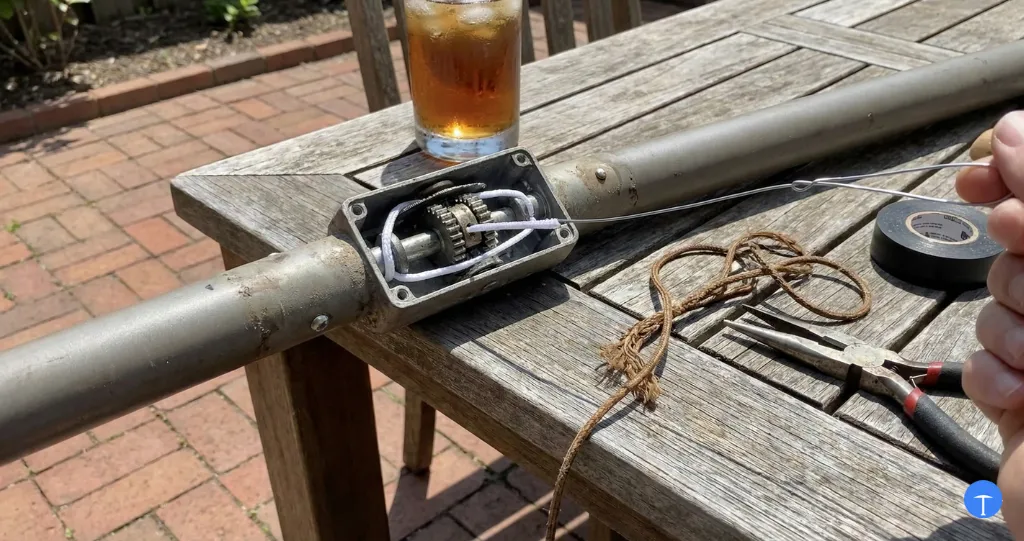
A broken patio umbrella string is one of the most common issues with pulley operated umbrellas. The good news is that fixing it yourself takes about 30 minutes and costs under $15 in materials. This guide walks you through the entire patio umbrella cord replacement process, from identifying the problem to testing your completed repair.
Before you start pulling things apart, make sure the string is actually the problem.
Visible fraying is the most obvious indicator. Check the exposed portion of your cord where it exits the pole. Fuzzy fibers or thin spots mean replacement is coming soon.
The umbrella won’t stay open even when you pull the lift cord tight. This usually means the cord has stretched or the knot at the top has come loose.
Sticking or jerky movement when raising the canopy suggests the cord is catching on a fray or wrapped incorrectly around the pulley.
Complete failure is hard to miss. The pull cord snaps and you are left holding a handle with broken rope attached.
If your crank handle spins without raising the umbrella, that is a different repair. Check our guide on fixing patio umbrella crank mechanisms for that problem.
Gather everything before you start. Nothing is worse than having your umbrella half disassembled and realizing you need a hardware store run.
| Item | Specification | Approximate Cost | Where to Buy |
|---|---|---|---|
| Replacement cord | 3mm to 4mm diameter polyester or nylon, 10 to 15 feet | $5 to $10 | Amazon, hardware stores, marine supply shops |
| Screwdriver set | Phillips and flathead, multiple sizes | $10 to $20 | Any hardware store |
| Scissors | Sharp enough to cut cord cleanly | $5 | Dollar store or home |
| Lighter or heat source | Standard butane lighter | $2 | Gas station, grocery store |
| Silicone lubricant | Spray or liquid, not WD-40 | $6 to $10 | Hardware store |
| Replacement end caps | Match your pole diameter | $3 to $8 | Umbrella manufacturer, Amazon |
For most market umbrellas, 3.5mm braided polyester is ideal. Marine grade cord resists UV damage and moisture exceptionally well.
Not all umbrella pulleys work the same way. Identify your type before removing anything.
Most basic patio umbrellas use a single pulley mounted inside the hub at the top of the pole. The cord runs straight up from the handle, over the pulley wheel, and attaches to the runner that slides up and down.
Single pulley systems are the easiest to restring. The cord path is straightforward and you can often complete the repair without removing the canopy.
Larger umbrellas and commercial grade models use two pulleys to distribute lifting force. The cord runs up, over the first pulley, across to the second, then down to the runner.
Understanding umbrella tilt mechanisms helps you navigate internal components since tilt systems often share space with the pulley assembly.
Close the umbrella completely and lay it on a flat surface with something soft underneath to protect the fabric.
Unwrap any remaining cord from the cleat on the pole. Locate the end cap at the bottom, which usually twists off counterclockwise. Some require a screwdriver to remove a set screw first.
Pull the old cord down and out through the bottom. If it jams, work it back and forth gently without yanking hard enough to damage the pulley.
Take a quick photo with your phone before removing the cord completely. This saves confusion when threading the new one.
For cantilever designs, cord routing differs significantly, so reference that specific guide.
Use your old cord as a measuring guide if it came out intact. Add two feet for working room since you can trim excess but cannot add length.
If your old cord is too damaged to measure, here is a general formula: measure the pole height and multiply by 2.5 for single pulley systems or 3 for double pulley systems. A standard 9 foot umbrella typically needs about 20 feet of replacement umbrella cord.
Cut with sharp scissors for a clean end. Immediately seal both ends with a lighter flame until the fibers melt into a smooth tip. This prevents unraveling and makes threading easier.
Take your time here. Patience now means a repair that lasts for years.
Start at the top of the umbrella pole. Feed your new cord down through the pulley opening in the hub. The sealed end should slide through without catching. A small amount of silicone lubricant helps with tight spots.
Guide the cord over and around the pulley wheel. For single pulley systems, it goes straight down through the pole. For double pulleys, route from the first pulley to the second before sending it down.
Use a flashlight to confirm the cord seats properly in the pulley groove, not beside it.
Once the cord exits the bottom of the pole, attach it to the runner mechanism. The runner usually has a small hole or molded hook for this purpose.
The figure eight knot is ideal for umbrella cord. Make a loop about 4 inches from the end, wrap the end around and back through to form the shape of an 8, then pull tight.
For extra security, tie a second figure eight directly against the first. This creates a stopper knot that cannot pull through under load.
Trim excess to about one inch past the knot and seal the cut end with your lighter.
Stand the umbrella upright and pull the cord slowly to raise the canopy. Movement should feel smooth with consistent resistance. Any jerking means the cord is hung up inside.
Open fully and wrap the cord around the cleat. The umbrella should stay open without creeping downward. If it slowly closes, wrap the cord one additional time.
Test the full cycle at least five times before considering the job done.
Keep your patio umbrella string repair from becoming a regular chore.
Close your umbrella when not in use to protect the cord from UV exposure. Lubricate the pulley once per season with silicone spray. Inspect the cord monthly during heavy use season to catch fraying early. Learning how to keep your patio umbrella from blowing away also reduces stress on the cord and pulley system.
Proper winter storage prevents moisture damage to the cord and pulley. Following patio umbrella safety practices extends component life across the board.
Most patio umbrellas use 3mm to 4mm diameter braided polyester or nylon cord. Polyester resists UV damage and stretches less than nylon over time. Marine grade cord handles outdoor conditions extremely well.
With normal use and proper care, umbrella cord typically lasts 3 to 5 years. Heavy use and constant sun exposure can shorten this to 1 to 2 years. Premium marine grade cord often exceeds 5 years.
No. The cord must fit the pulley groove and grip in the cleat. Cotton rope, paracord, and other common ropes stretch too much, absorb water, or lack UV resistance. Use braided polyester or nylon designed for outdoor applications.
Tangling usually happens when the cord is too long or the umbrella is lowered too quickly. Excess cord bunches inside the pole instead of feeding smoothly. Shorten the cord slightly and lower slowly.
DIY restringing costs $5 to $15 for materials. Professional services typically charge $30 to $75. Given the simplicity of this repair, doing it yourself saves money and time.
Fixing the string makes sense when the umbrella itself is in good condition.
Consider replacing the entire umbrella if the pole is bent or corroded, the canopy is faded or torn beyond cleaning, or the pulley mechanism is cracked. Understanding all the parts of your patio umbrella helps you assess overall condition.
Repair makes sense when the cord is the only failed component and the umbrella is otherwise solid. A $10 string replacement on a quality umbrella that has years of life left is an obvious win.
Replacement cord is available at most hardware stores in the rope and chain aisle. Marine supply shops and Amazon carry specialty umbrella cord with ideal specifications. Some manufacturers sell parts directly, ensuring perfect compatibility with your model.
Once you have mastered this repair, explore our complete patio umbrella guide to learn more about choosing, maintaining, and getting the most from your outdoor shade solution.