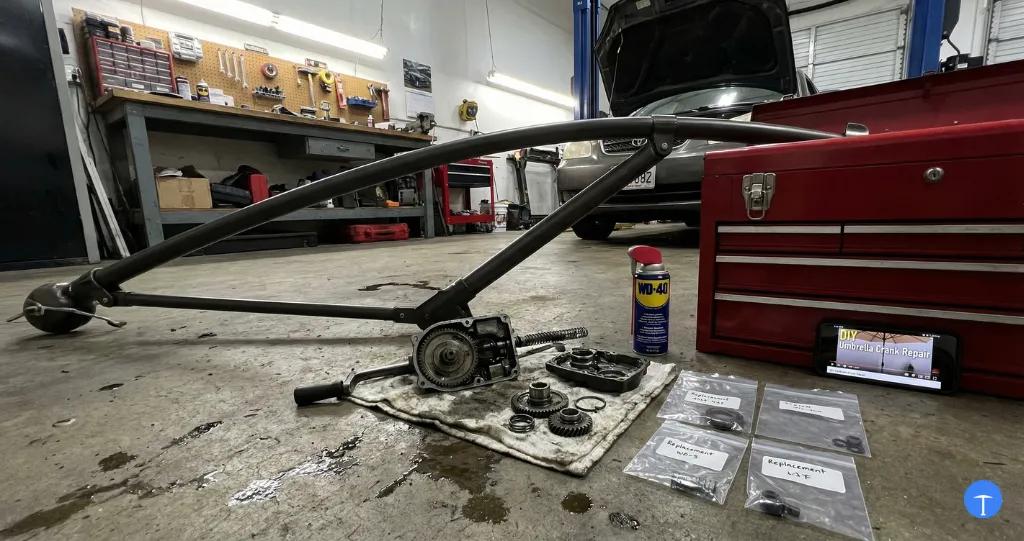
Cantilever umbrellas are the workhorses of serious outdoor spaces, but their offset design means they fail differently than standard patio umbrellas. When your cantilever umbrella starts drooping, refuses to rotate, or the crank stops working, you’re dealing with a more complex hanging patio umbrella fix than a typical market umbrella would require.
The good news? Most cantilever umbrella problems are fixable at home with basic tools. This guide walks you through diagnosing issues, sourcing parts, and making repairs safely. For general patio umbrella information, we cover all types, but cantilevers deserve their own deep dive.
Before diving into repairs, understanding what makes cantilevers unique helps you troubleshoot faster. Unlike market umbrellas that support the canopy from a center pole, cantilever umbrellas use an offset design where the pole and support structure sit to one side. The canopy hangs from a cross arm, creating shade without a pole in your way.
This design requires additional engineering: rotation hubs, tilt mechanisms, heavier bases, and support cables that standard umbrellas don’t need. The cross arm bears significant stress, and the structure experiences different forces when wind hits. Your cantilever has more moving parts, more failure points, and often brand-specific components that make repairs trickier.
The offset weight distribution also means cantilever umbrellas need substantial bases to prevent tipping. When something feels off, the problem could originate in the canopy, mechanism, or base.
Understanding typical offset umbrella problems helps you diagnose issues faster. When your offset umbrella won’t stay up or mechanisms fail, this diagnostic table helps identify what’s wrong and whether you can tackle the cantilever umbrella repair yourself.
| Problem | Possible Causes | DIY Difficulty | Parts Needed |
|---|---|---|---|
| Canopy won’t stay raised | Worn lift cable, damaged crank mechanism, broken gas strut | Moderate | Lift cable, crank parts, or gas strut |
| Umbrella droops to one side | Bent rib, failed tension cable, cross arm damage | Moderate to Hard | Replacement rib, cable, or cross arm |
| Rotation mechanism stuck | Debris in hub, corroded bearings, seized swivel | Easy to Moderate | Lubricant, possibly bearing kit |
| Tilt won’t hold position | Stripped tilt gear, worn locking pin, damaged tilt motor | Moderate | Tilt mechanism parts |
| Crank not engaging | Stripped gears, broken handle, disconnected cable | Easy to Moderate | Crank handle or internal gears |
| Cross arm bent or damaged | Wind damage, improper storage, material fatigue | Hard | Replacement cross arm |
| Base wobbling | Loose hardware, cracked base, inadequate weight | Easy | Hardware kit, additional weight |
A cantilever umbrella drooping on one side or refusing to stay fully open is the most common complaint. The causes vary, so work through these systematically.
Many cantilever umbrellas use a tension system that keeps the canopy taut when open. Look for adjustment points where the canopy connects to the frame. Some models have tensioning straps or turnbuckles that can be tightened. If your canopy fabric has stretched, tensioning alone might not solve the problem, but it’s the easiest fix to try first.
Check the tension evenly around the canopy. Uneven tension causes lopsided sagging and stresses individual ribs.
Cantilever ribs take more abuse than market umbrella ribs because of the offset weight distribution. Inspect each rib with the umbrella in both open and closed positions. Look for bends, cracks at joints, and corrosion where metal meets metal.
If a rib is bent but not cracked, you may be able to straighten it carefully. Aluminum ribs are forgiving; fiberglass ribs will break if you try to bend them. For cracked or broken ribs, cantilever umbrella rib replacement is your only option. Measure the rib length and diameter before ordering, and note whether your model uses straight or curved ribs.
The support cables that connect the canopy structure to the main mast carry significant load. Unlike market umbrella strings that run through the center pole, cantilever cables often run externally along the cross arm and mast. Frayed, loose, or stretched cables all cause drooping.
Inspect cable anchors and pulleys for wear. If cables have frayed, replace them before they snap completely. Most cantilever cables are brand specific, so check with your manufacturer or measure precisely if sourcing aftermarket options.
The 360 degree rotation is a major selling point for cantilever umbrellas, but the rotation hub takes constant abuse from weather and use. When rotation becomes stiff or stops entirely, start with the simplest solutions.
Clean debris from around the rotation base. Leaves, dirt, and grit accumulate and bind the mechanism. Use a stiff brush and compressed air to clear everything out. Apply a silicone-based lubricant to the rotation hub, never WD-40, which attracts more dirt.
If cleaning and lubrication don’t restore smooth rotation, the internal bearings may be worn or corroded. Some models allow bearing replacement; others require replacing the entire rotation hub. This is where having your model number pays off when ordering parts.
For offset umbrella rotation problems that persist after cleaning, check whether the umbrella is sitting level. An unlevel base puts side pressure on the rotation mechanism and causes binding.
Cantilever tilt systems vary widely between manufacturers. Some use manual tilt levers, others have crank-operated tilt, and premium models may include motorized tilt. The repair approach depends on your system type.
For manual tilt that won’t hold position, the locking mechanism is usually the culprit. Check for stripped teeth on tilt gears or worn locking pins. These parts are often replaceable without buying the entire assembly.
Crank-operated tilt failures typically stem from stripped gears or disconnected linkage. Access the mechanism housing, usually where the cross arm meets the mast. Take photos before disassembly.
If your cantilever umbrella tilt fix requires parts, contact the manufacturer with your model number. Tilt mechanisms are rarely universal between brands.
Cantilever crank systems differ from standard patio umbrella cranks because they often drive cables, gas struts, or hydraulic assists rather than a simple pulley. When your cantilever umbrella mechanism stops working, identify your lift system type.
Cable-driven systems: The crank winds a cable that pulls the canopy up through a pulley arrangement. If the crank spins freely without raising the canopy, the cable has likely disconnected or broken. This is a common offset umbrella crank repair that most homeowners can handle.
Gas-strut-assisted systems: These use one or more gas struts to help lift the heavy canopy. If the cantilever umbrella gas strut has failed, the umbrella becomes difficult to open and won’t stay up. Gas struts are replaceable, but sizing is critical. Measure the extended length, compressed length, and force rating of your existing strut.
For crank handles that have snapped or stripped, replacement handles are often available. Match shaft size and shape carefully. Square shafts and hex shafts are not interchangeable.
The cross arm holds the canopy away from the main pole and carries constant bending stress. A bent cross arm throws off umbrella geometry, causing uneven canopy tension and mechanism strain.
Minor bends in aluminum cross arms can sometimes be corrected, but aluminum work hardens and can crack. Significantly bent or cracked cross arms need replacement. Cross arms are almost always brand specific and can be expensive.
Support arms connecting the cross arm to the mast may also bend or break. Inspect connection points for cracks around bolts and joints. Tighten loose hardware but don’t overtighten, which can crack cast fittings.
Cantilever umbrella base problems often manifest as wobbling, which is both annoying and dangerous. The offset design puts tremendous leverage on the base. Check all bolts at the base connection and tighten them. Look for cracks in the base plate or housing.
If your base uses weight bags or plates, verify they’re adequate. Cantilever umbrellas typically need more base weight than market umbrellas. Review umbrella safety recommendations for your canopy size. For cracked or broken bases, replacement is necessary since a tipping cantilever can cause serious injury.
Finding replacement parts for cantilever umbrellas can be frustrating. This table shows typical availability and costs.
| Part | Universal Available | Brand Specific | Typical Cost Range |
|---|---|---|---|
| Canopy replacement | Yes, with careful sizing | Often for premium brands | $80 to $300 |
| Ribs | Sometimes | Usually | $15 to $60 per rib |
| Crank mechanism | Rarely | Almost always | $40 to $150 |
| Rotation hub | No | Yes | $50 to $200 |
| Tilt mechanism | No | Yes | $60 to $180 |
| Cross arm | No | Yes | $100 to $400 |
| Support cables/cords | Sometimes | Often | $20 to $80 |
Start your parts search with the manufacturer. Keep your model number handy since cantilever umbrella parts are rarely interchangeable between brands. If the manufacturer can’t help, measure precisely and search parts suppliers with your exact dimensions.
For older umbrellas where parts are unavailable, umbrella repair specialists can sometimes source compatible components or fabricate replacements.
Extend your cantilever umbrella’s life with regular maintenance. After every use, close the umbrella and engage any locks. Before seasonal storage, clean all mechanisms and apply silicone lubricant to rotation hubs, tilt pivots, and cable pulleys.
Inspect ribs and cables at the start of each season for corrosion, fraying, and loose connections. Proper winter storage is especially important for cantilevers because their complex mechanisms are vulnerable to moisture damage. During windy conditions, close and secure your cantilever using tips for keeping your umbrella secure.
The most common causes are a failed gas strut, stretched lift cable, or worn crank mechanism. Check the lift system first. If the umbrella falls slowly, it’s likely a strut or cable issue. If it drops suddenly, look for broken lift mechanism components.
Yes, canopy replacement is one of the easier cantilever repairs. Measure your existing canopy carefully and note the number of ribs. Universal replacement canopies work for many models, though premium brands may require brand-specific canopies for proper fit.
Start by cleaning debris from the rotation hub and applying silicone lubricant. If the base is unlevel, the rotation mechanism binds. Persistent problems usually indicate worn bearings needing replacement.
Rarely. Canopies and some hardware are more universal, but mechanisms, cross arms, and structural components are almost always brand specific. Always check compatibility before ordering.
Quality cantilever umbrellas last 5 to 10 years with proper care. Canopies may need replacement sooner due to UV fading. Mechanisms and frames last longer if maintained and stored properly.
It depends on the problem and parts cost. If repairs exceed 40 to 50 percent of replacement cost, consider whether a new cantilever umbrella makes more sense. Factor in the age of other components since fixing one part doesn’t prevent others from failing.
Some cantilever repairs are best left to professionals. Consider getting help with motorized tilt systems, hydraulic components, or complex internal mechanisms. If under warranty, professional repair preserves coverage.
Safety matters too. Cantilever umbrellas are heavy and awkward. Repairs requiring fully extending a damaged umbrella or working with tensioned components can be dangerous. For valuable umbrellas where parts are unavailable, specialists can sometimes fabricate components.