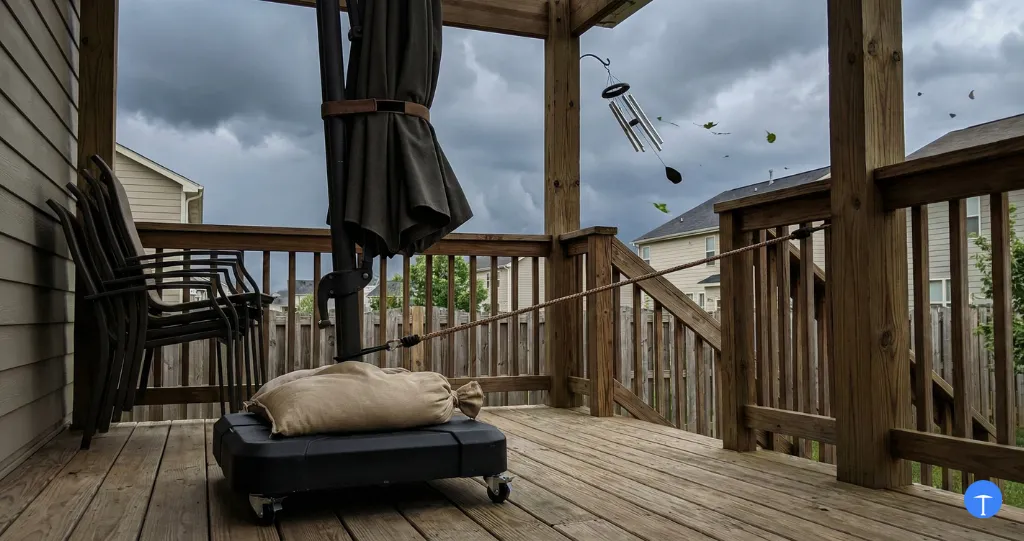
A secure patio umbrella starts with the right base weight and proper anchoring for your setup. If your umbrella has already taken flight, crashed into patio furniture, or ended up in the neighbor’s yard, you know the frustration of dealing with bent frames and awkward conversations. The good news is that learning how to keep your patio umbrella from blowing away comes down to understanding why it happens and applying the right securing methods for your situation.
Your patio umbrella acts like a giant sail when the wind picks up. The canopy catches air and creates lift, while the pole provides a pivot point that amplifies any force pushing against it. Even moderate gusts can generate enough pressure to tip an umbrella that seemed stable moments earlier.
Several factors determine vulnerability. Larger canopies catch more wind. Taller poles create more leverage against your base. Your outdoor space can channel and accelerate breezes that seem mild elsewhere. Understanding these parts of your patio umbrella and how they interact with wind helps you choose the right umbrella wind protection strategy.
The physics are straightforward: once wind force exceeds the holding power of your base and anchoring system, your patio umbrella starts flying away.
A properly weighted umbrella base is your first defense against a patio umbrella blowing over. The general rule is 10 pounds of base weight for every foot of canopy diameter. A 9 foot umbrella needs at least 90 pounds, while an 11 foot canopy calls for 110 pounds minimum.
This is a starting point rather than a guarantee. Windy locations need more weight. Cantilever umbrellas require heavier bases because of the leverage working against them. For a complete breakdown of requirements, check our guide on what size umbrella base you need.
Sometimes you have a base that works most days but needs extra weight for gusty conditions. Adding weight is often cheaper than buying a new base.
Sandbags designed for umbrella bases typically weigh 15 to 20 pounds each and wrap around the pole or stack on your existing base. Weight plates fit over the pole and rest on the base, adding 30 to 50 pounds. The advantage is flexibility. Use them when conditions call for extra security and remove them when weather is calm.
Concrete pavers stacked on your base platform add significant weight at minimal cost. A 16 inch square paver weighs around 30 pounds. Pea gravel in a tray surrounding the pole works similarly. Whatever solution you choose, make sure weight is distributed evenly and cannot shift. Unbalanced weight can make tipping more likely.
For umbrellas in grass, soil, or sand, an umbrella ground anchor provides serious holding power that a freestanding base cannot match. A proper anchor patio umbrella setup uses a metal auger that screws into the ground and holds the pole securely.
Ground stakes work for lighter applications. Spiral stakes driven into turf at an angle and connected by straps create multiple anchor points. The key is soil condition. Dry, sandy soil provides less grip than moist, compacted earth. Loose soil requires longer anchors and multiple attachment points.
A deck mount eliminates the base by bolting the pole directly to your deck structure. This is the most secure option and the best choice if you have experienced an umbrella flying away despite a heavy base.
Surface mounts bolt on top of deck boards. Flush mounts sit level with the surface. Through deck installations anchor to the underlying framing. Professional installation ensures the mount attaches to solid framing rather than just deck boards. If you have a cantilever umbrella, specialized mounts account for the offset load. For cantilever issues, see our cantilever umbrella repair guide.
Patio tables with umbrella holes provide support, but the hole alone does not secure your umbrella against wind. Through table installations with a ground sleeve beneath anchor the pole at two points instead of one.
A cone wedge inside the table hole reduces wobble and prevents the pole from rattling loose. The limitation is that securing options depend on what is beneath the table. Concrete allows ground sleeves. Decks may need additional base weight below.
An umbrella tie down connects your closed umbrella to a fixed point, preventing it from opening unexpectedly. This is useful for umbrellas that stay outside when not in use.
Straps run from the pole to deck railings, fence posts, or ground stakes. Bungee straps provide flex while maintaining tension. Ratchet straps lock tight. Tie downs offer peace of mind when sudden storms roll in while you are away. They work best as backup to proper base weight rather than a primary method.
Where you place your umbrella affects how much wind it catches. Positioning near a wall, fence, or building creates a wind shadow that shields the canopy. Corner positions between two walls offer more protection.
Avoid open areas far from any windbreak. The middle of a large patio exposes your umbrella to wind from every direction. Moving your setup a few feet closer to a structure can stop umbrella tipping that seemed unavoidable.
Pay attention to prevailing wind direction. Position so wind approaches from the shielded side. If your space does not allow protective positioning, choosing a windproof patio umbrella designed for exposed locations becomes important.
| Method | Effectiveness | Cost | Best For | Limitations |
|---|---|---|---|---|
| Heavier base | High | $50 to $200 | All umbrella types | Weight makes moving difficult |
| Sandbags/weight plates | Moderate to High | $20 to $60 | Adding to existing base | May shift if not secured |
| Ground anchors | Very High | $30 to $100 | Grass and soil installations | Requires soft ground |
| Deck mount | Very High | $50 to $150 plus installation | Permanent deck setups | Permanent modification required |
| Table mount | Moderate | $20 to $50 | Table umbrellas | Depends on surface below table |
| Umbrella straps | Moderate | $10 to $30 | Backup security | Only works when closed |
| Wind vent umbrella | Moderate | $100 to $400 | Windy areas | Still needs proper base weight |
Wind vents are openings in the canopy that let air pass through instead of catching it. Most quality umbrellas include at least one vent near the top. Some designs feature double vents.
Vents reduce lift force but do not eliminate it. Think of vents as reducing wind load by 20 to 30 percent rather than making your umbrella windproof. A vented canopy still needs proper base weight. When shopping, look for vents designed into the canopy with reinforced edges rather than simply cut out.
No securing method works against all conditions. Learning what wind speed requires closing your umbrella protects your umbrella and property. According to the National Weather Service, winds above 25 mph can move unsecured objects. Even secured umbrellas can fail in these conditions.
Building a habit of closing when you finish using it prevents surprise damage. Quick release mechanisms that let you close in seconds encourage this habit by removing inconvenience. Look for crank systems or push button releases that work smoothly.
Weather apps with wind alerts give advance warning. Setting a notification for winds above 15 mph lets you act before it becomes urgent. For comprehensive patio umbrella safety guidance beyond wind, see our dedicated guide.
Use the 10 pounds per foot rule as a starting point. A 9 foot umbrella needs at least 90 pounds. Windy locations and cantilever designs require additional weight beyond this minimum.
Yes, wind vents reduce air pressure by allowing some wind to pass through, typically decreasing load by 20 to 30 percent. However, vents complement proper base weight rather than replacing it.
The best method depends on your surface. Deck mounts offer most security for wooden decks. Ground anchors work for grass and soil. Heavy weighted bases suit concrete patios.
Sandbags add 15 to 40 pounds and improve stability in moderate wind. They work best combined with a base that already meets minimum weight requirements rather than as a standalone solution.
Yes, closing when not in use is the most effective way to prevent wind damage. An open unattended umbrella catches sudden gusts that a closed umbrella would easily withstand.
If your umbrella has escaped, assess damage before attempting repairs. Check the pole for bends. Inspect the ribs for breakage. Examine the canopy for tears. Minor damage is often repairable, but structural pole damage usually means replacement.
If your umbrella damaged a neighbor’s property or injured someone, address it promptly. According to the Insurance Information Institute, homeowner’s insurance typically covers liability for damage your property causes. Contact your provider to understand coverage and document the incident with photos before cleanup.
Review what failed. Was the base too light? Did wind come from an unexpected direction? Did you leave it open when it should have been closed? Use what you learn to upgrade your securing setup.
For more patio umbrella guides and resources, browse our complete collection. For seasonal storage that protects your umbrella, our guide on storing your patio umbrella for winter covers everything you need.