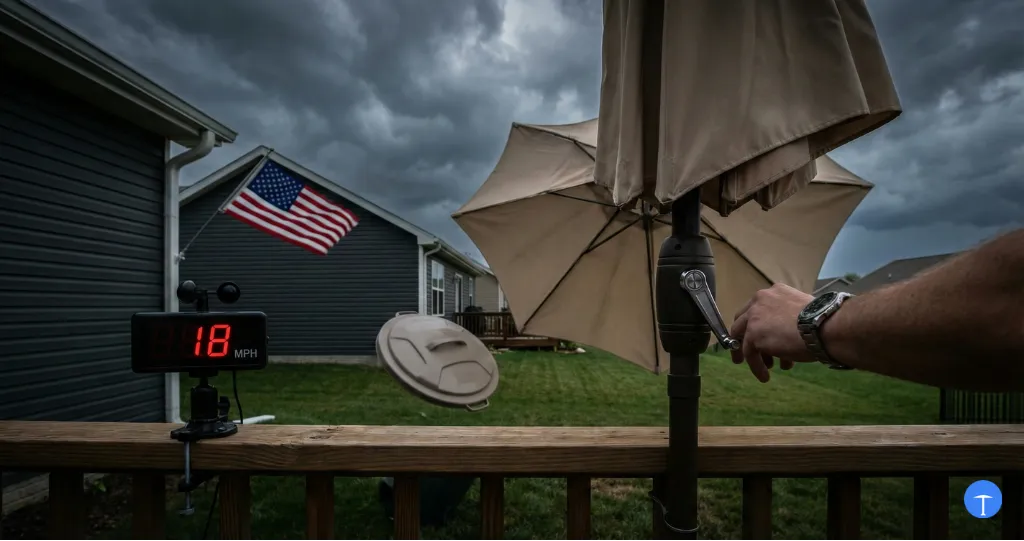
Close your patio umbrella when wind speeds reach 15 to 20 MPH for standard residential umbrellas. This threshold drops to 10 to 15 MPH for cantilever designs, while commercial-grade umbrellas can handle 25 MPH or more. The actual limit depends on your umbrella type, mounting method, and whether you’re dealing with sustained wind or gusts.
Most residential patio umbrellas should be closed when wind speeds hit 15 to 20 MPH. That’s the speed where leaves start blowing around and you’ll feel a consistent push against your body when standing outside. At this point, your umbrella canopy acts like a sail, creating significant stress on the pole, ribs, and base.
If you live in a consistently windy area, consider exploring umbrellas designed for windy conditions with higher wind ratings and vented canopies.
Wind ratings tell you the maximum sustained wind speed an umbrella can theoretically handle. However, manufacturers test under controlled conditions with steady airflow. Real wind gusts, swirls, and changes direction, creating stress that exceeds what steady wind would cause.
These ratings also assume perfect conditions: a new umbrella, properly weighted base, and no wear on components. Your three-year-old umbrella won’t perform like it did on day one.
Cantilever umbrellas have the lowest wind tolerance at 10 to 15 MPH, standard market umbrellas handle 15 to 20 MPH, and commercial-grade models can withstand 25 to 35 MPH. Use this table as your reference for when to close your umbrella and when to bring it inside entirely.
| Umbrella Type | Close Umbrella | Consider Bringing Inside | Secure or Remove |
|---|---|---|---|
| Market umbrella (standard) | 15 to 20 MPH | 25 to 30 MPH | 35+ MPH |
| Market umbrella (wind-vented) | 20 to 25 MPH | 30 to 35 MPH | 40+ MPH |
| Cantilever umbrella | 10 to 15 MPH | 20 to 25 MPH | 30+ MPH |
| Commercial grade | 25 to 35 MPH | 40 to 45 MPH | 50+ MPH |
| Beach umbrella | 10 to 15 MPH | 15 to 20 MPH | 25+ MPH |
Standard market umbrellas with center poles should close at 15 to 20 MPH. The center-pole design provides good stability, but the canopy still catches significant wind. Models with wind vents get an extra 5 MPH buffer because air can escape through the top rather than lifting the entire umbrella.
Cantilever umbrellas need more conservative thresholds, typically 10 to 15 MPH. The offset design creates leverage that works against stability since the canopy sits away from the base. If your cantilever needs maintenance, check our guide on fixing cantilever umbrella issues.
Commercial umbrellas built for restaurants and resorts can handle 25 to 35 MPH sustained winds. These feature heavier frames, reinforced ribs, and engineered bases. However, even commercial umbrellas should come down during storms or sustained high winds.
Base weight matters enormously. A properly sized umbrella base provides the stability needed to hit rated wind speeds. An undersized base drops your effective wind tolerance significantly.
Mounting type changes the equation too. Through-table mounts and in-ground permanent installations offer more stability than freestanding bases.
Umbrella condition plays a role as well. Worn fabric stretches and catches more wind. Corroded joints and weakened ribs fail at lower stresses than new components.
Weather apps on your phone provide current wind speeds and forecasts. Look for apps that show both sustained wind and gust predictions since gusts matter more for umbrella safety.
Local weather services publish detailed forecasts including hour-by-hour wind predictions. Smart home weather stations have become affordable and provide real-time readings from your actual location.
When you don’t have access to wind speed data, the Beaufort scale lets you estimate conditions by watching your environment.
| Beaufort Number | Wind Speed (MPH) | Visual Indicators | Umbrella Action |
|---|---|---|---|
| 0 to 2 | 0 to 7 | Smoke rises vertically, leaves barely move | Safe to use |
| 3 | 8 to 12 | Leaves and small twigs move constantly | Safe with monitoring |
| 4 | 13 to 18 | Small branches move, dust and paper blow | Close standard umbrellas |
| 5 | 19 to 24 | Small trees sway, wavelets on ponds | Close all residential umbrellas |
| 6 | 25 to 31 | Large branches move, whistling in wires | Bring umbrellas inside |
| 7+ | 32+ | Whole trees sway, walking becomes difficult | Secure or remove all umbrellas |
Watch the trees around your patio. When small branches start moving continuously, you’re approaching the threshold where most umbrellas should be closed.
Always base your umbrella decisions on gust speed, not sustained wind. Weather forecasts report both: sustained wind is the average over two minutes, while gusts are brief increases that can be 30 to 50 percent higher. If the forecast shows sustained 12 MPH with gusts to 20 MPH, treat it as a 20 MPH wind day for umbrella purposes.
Gusts cause more damage than sustained wind because they create sudden stress on components from unexpected directions.
At 20 to 25 MPH, you’ll see canopy fabric straining and poles flexing. Continued exposure leads to stretched fabric and bent ribs over time.
At 25 to 35 MPH, individual ribs can bend or break, the canopy can tear at stress points, and poles may bend with undersized bases.
Above 35 MPH, the umbrella can become airborne, bases can tip, and the entire assembly can cause property damage or injury. Following proper patio umbrella safety practices prevents these scenarios.
Check the forecast before setting up your umbrella for the day. If afternoon gusts are predicted, plan to close it before conditions deteriorate.
For events, have a closure plan ready. Designate someone to monitor conditions and close umbrellas if wind picks up unexpectedly.
If you’re going on vacation, close and secure your umbrella before leaving. Better yet, store it properly until you return. Learn the best practices for storing your patio umbrella to protect your investment.
No patio umbrella can safely remain open in high winds. Even commercial umbrellas rated for 35 MPH or more should be closed during storms. The physics of a large fabric canopy catching wind creates forces that exceed any design’s limits.
Wind damage progresses from minor to severe. First the canopy stretches and frame flexes repeatedly. Then ribs bend or break, fabric tears, and poles may bend. In extreme cases, the umbrella can become airborne, damaging property or injuring people.
Use the Beaufort scale by observing your surroundings. When leaves and small twigs move constantly, you’re around 10 MPH. When small branches move and debris blows, you’ve hit 15 MPH. When larger branches sway, you’re approaching 25 MPH.
Rain alone doesn’t damage most patio umbrellas designed for outdoor use. However, rain often accompanies wind, and wet canopy fabric is heavier, increasing stress on components. Close your umbrella during rain if wind accompanies it or if the rain is heavy enough to pool on the canopy.
Damage typically starts at 25 to 30 MPH for standard residential umbrellas, though repeated exposure to lower winds causes cumulative wear. Cantilever models may show damage at 20 MPH or less. The threshold depends on umbrella quality, age, base weight, and whether conditions involve gusts.
When you’re unsure whether to close your umbrella, close it. The inconvenience of losing shade never outweighs the cost of replacing a damaged umbrella.
Pay attention to trends, not just current conditions. If wind is increasing or your weather app shows gusts coming, close before they arrive.
For more strategies on keeping your patio umbrella from blowing away, check our comprehensive guide on securing methods. And remember that choosing the right umbrella for your conditions makes these decisions easier from the start.