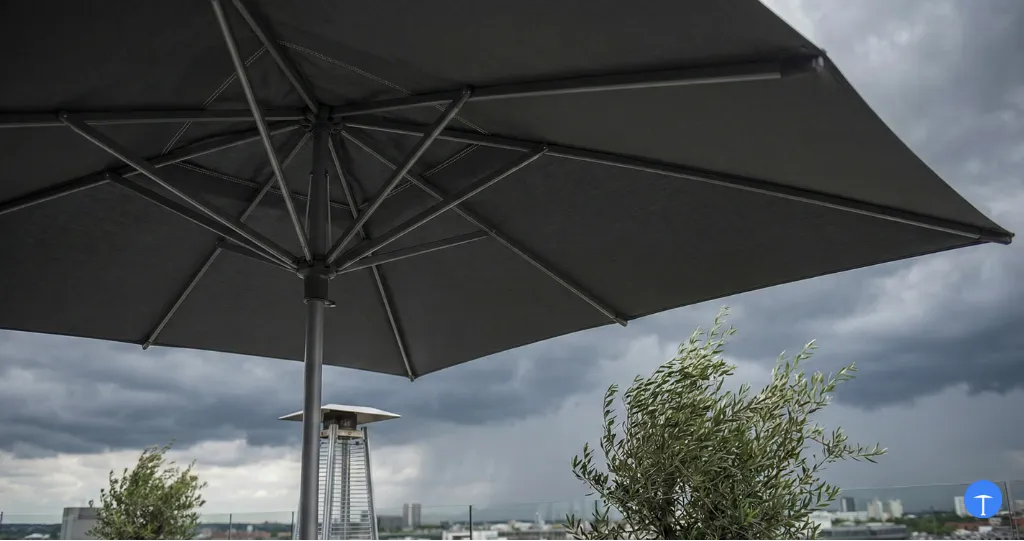
No patio umbrella is truly windproof, but some resist wind far better than others. The difference comes down to specific design features and umbrella construction quality that allow a canopy to flex, release pressure, and stay anchored when gusts hit. Understanding what makes an umbrella wind-resistant helps you evaluate what actually matters when shopping for a windproof patio umbrella.
The best wind-resistant umbrellas combine multiple features working together as a system, with fiberglass umbrella ribs, vented canopies, and quality hardware all contributing to overall durability.
When manufacturers label an umbrella “windproof,” they mean it resists moderate winds better than standard models. True windproof performance would mean surviving hurricane conditions, which no consumer umbrella can claim. Think of wind resistance as a spectrum where budget umbrellas struggle with light breezes while commercial-grade options handle sustained winds that would destroy lesser products.
Umbrella wind ratings offer some guidance but require context. A 25 mph rating measured in controlled laboratory conditions tells a different story than real-world performance where gusts spike unpredictably. For detailed information on interpreting these specifications and understanding wind load capacity, see our guide on how much wind patio umbrellas can withstand.
The umbrella frame materials establish the foundation for wind resistance. Each option balances strength, flexibility, weight, and cost differently.
| Material | Wind Resistance | Weight | Durability | Cost | Best For |
|---|---|---|---|---|---|
| Fiberglass ribs | Excellent | Light | High | Medium | Windy coastal areas |
| Aluminum frame | Good | Light | Medium | Medium | General residential use |
| Steel frame | Moderate | Heavy | High | Low to Medium | Protected patios |
| Wood frame | Low | Heavy | Medium | High | Decorative settings |
| Mixed (aluminum pole/fiberglass ribs) | Excellent | Light | High | Medium to High | Best overall performance |
Fiberglass has transformed umbrella construction for windy environments. Unlike rigid materials that reach a breaking point, fiberglass bends dramatically under pressure and returns to its original shape. The best flexible umbrella ribs bend up to 180 degrees without breaking. Watch for diameter and wall thickness when comparing options, as thin, hollow fiberglass tubes sacrifice much of the material’s advantages.
Aluminum dominates the mid-range umbrella market, offering reasonable wind resistance at moderate prices. The material resists corrosion and weighs less than steel, making it practical for umbrellas you open and close frequently.
Wind performance depends heavily on alloy quality and wall thickness. Cheap aluminum tubes dent and bend permanently under stress, while commercial-grade aluminum holds up significantly better. Many quality umbrellas pair aluminum poles with fiberglass ribs for a durable patio umbrella that handles challenging conditions.
Steel frames provide raw strength but add weight and rust concerns. They work adequately in protected areas but become liabilities in strong winds because they either hold firm or fail completely with little middle ground. Regular painting or powder coating helps prevent corrosion.
Wood frames prioritize aesthetics over wind performance. The natural material looks beautiful on covered patios but lacks both the flexibility of fiberglass and the strength of metal. Reserve wooden umbrellas for calm environments or bring them indoors at the first sign of wind.
Beyond material choice, rib engineering matters enormously. The way ribs connect to the hub, their profile shape, and their mounting angle all affect wind response. Look for ribs that attach with spring-loaded joints rather than rigid pins. Spring connections allow controlled movement that dissipates wind energy rather than transferring full force to connection points.
Rib count also plays a role in outdoor umbrella durability. Eight-rib designs spread load more evenly than six-rib versions, reducing stress on any single component. Some commercial umbrellas use ten or twelve ribs for maximum stability, though this adds cost and mechanical complexity.
Vented canopies rank among the most effective umbrella wind features available. The concept is simple: instead of trapping air underneath like a sail, vents allow wind to pass through, reducing the lifting force that wants to flip your umbrella. Single vents help noticeably, but double-vented designs provide superior pressure release during stronger gusts.
Vent placement and size vary between manufacturers. Top-mounted vents in the canopy peak release rising air while side vents manage horizontal gusts. The specific benefits and tradeoffs between different vent configurations deserve more attention than we can give here. For a complete breakdown, see our comparison of vented vs non-vented umbrellas.
Canopy fabric weight and weave density affect both wind performance and longevity. Heavier fabrics, measured in grams per square meter, typically withstand wind stress better than lightweight alternatives. Solution-dyed acrylics and marine-grade polyesters lead the market for storm-resistant umbrella performance.
Weave tightness matters beyond water resistance. Loose weaves allow fabric to flutter and stress stitching, while tight weaves distribute force evenly across seams. Quality umbrellas reinforce stress points with double stitching. Look for canopies secured at multiple points along each rib rather than just at tips.
The pole functions as the umbrella’s backbone. Pole diameter matters, with 1.5-inch minimums recommended for wind-prone areas and 2-inch or larger poles preferred for commercial applications. Wall thickness proves equally important since two poles with identical outer diameters perform very differently if wall gauges differ.
For cantilever umbrella designs, the support arm experiences torque forces concentrated at pivot points. Quality cantilevers use reinforced arm connections designed specifically for wind loads.
The hub sits where all ribs converge, making it a critical stress point during wind events. Cheap plastic hubs crack under repeated flexing, while metal hubs with proper engineering last for years. Hardware quality extends to every bolt and connection point. Stainless steel fasteners resist corrosion and maintain clamping force, while plated steel degrades outdoors.
Understanding how these umbrella parts work together helps you evaluate construction quality when shopping.
Shape geometry affects how much wind force an umbrella catches. Round canopies generally handle wind better than rectangular ones because they present a smaller effective surface area at any angle. Square canopies fall in between, while elongated rectangles catch the most wind when gusts hit perpendicular to the long dimension.
This doesn’t mean you should avoid rectangular umbrellas if your space requires that shape. It means you need to compensate with other wind-resistant features and potentially heavier bases. Position rectangular umbrellas with the short side facing prevailing winds when possible.
Push-up mechanisms have fewer moving parts that can fail, but crank systems allow you to react quickly to changing conditions. Neither design inherently resists wind better, but mechanism quality affects overall durability. Auto-tilt features add convenience but introduce additional failure points.
Tilted canopies catch wind differently than vertical ones. Button-tilt systems can slip under wind pressure if the locking pin wears. When wind picks up, returning your umbrella to vertical reduces the surface area catching gusts. Knowing what wind speed warrants closing your umbrella prevents umbrella wind damage from events exceeding design limits.
Commercial-grade patio umbrellas built for restaurants and resorts differ from residential models in several key ways that affect wind performance. Commercial frames typically use thicker-gauge aluminum or steel with reinforced connection points. Hardware tends toward marine-grade stainless steel rather than plated alternatives.
Canopy fabrics on commercial models often meet specific fire and fade resistance standards while using heavier base weights. Warranties reflect this quality difference, with commercial umbrellas commonly offering 3-5 year coverage compared to 1-2 years for residential products.
For homeowners in consistently windy areas, commercial-grade options may justify their higher price through longer service life and reduced replacement costs. The initial investment runs 2-3 times higher than comparable residential models, but the heavy-duty patio umbrella construction pays off in challenging environments.
Manufacturers test under controlled conditions with consistent wind speeds. Real outdoor environments feature turbulence, gusts, and swirling patterns that stress umbrellas differently. Look for ratings that distinguish between sustained wind tolerance and gust survival. A 30 mph sustained rating might handle 40 mph gusts briefly but fail under 35 mph sustained pressure.
No umbrella survives all wind conditions, so “windproof” really means more wind-resistant than average. Even commercial-grade umbrellas designed for restaurants have limits. Every umbrella should be closed or brought inside during severe weather.
Fiberglass ribs significantly outperform aluminum in windy conditions because they flex under pressure and return to shape rather than bending permanently or snapping. The best wind-resistant umbrellas combine fiberglass ribs with aluminum poles for optimal performance.
Round umbrellas handle wind better than rectangular ones because they present less surface area at any given wind angle. If you need a rectangular umbrella, compensate with a heavier base and other wind-resistant features like vents and flexible ribs.
Generally yes, since higher prices usually mean better materials, thicker construction, and quality hardware. However, some expensive umbrellas prioritize aesthetics over wind performance, so evaluate specific features rather than relying on price alone.
The most wind-resistant design combines fiberglass ribs, a thick aluminum pole, double-vented canopy, quality hardware, and a round shape. Few umbrellas include all these features, so prioritize based on your local wind conditions and budget.
Watch for these warning signs when evaluating umbrellas. Thin poles under 1.5 inches lack structural backbone for serious wind resistance. Rigid ribs made entirely of aluminum or plastic snap rather than flex. Single-piece plastic hubs crack at connection points under repeated stress.
Canopies without venting trap air and create lift forces that overwhelm other features. Loose fabric attachment allows fluttering that accelerates wear. Visible rust indicates materials that will fail when needed most.
Beyond umbrella construction, proper anchoring matters equally. Even the best umbrella needs an appropriate base for windy conditions and proper securing methods.
Focus on fiberglass ribs that flex and recover, adequate pole diameter and wall thickness, vented canopy design, quality metal hardware, and solid hub construction. Round shapes resist wind better than rectangular, but proper features matter more than shape alone.
The price-to-wind-resistance correlation holds generally but imperfectly. Budget umbrellas under $100 rarely include materials needed for serious wind resistance. Mid-range products ($150-300) often deliver the best value. Premium and commercial-grade options ($400+) make sense for consistently windy locations where cheaper umbrellas need frequent replacement.
Match your purchase to actual wind conditions rather than buying the most wind-resistant option available if you live in calm areas.