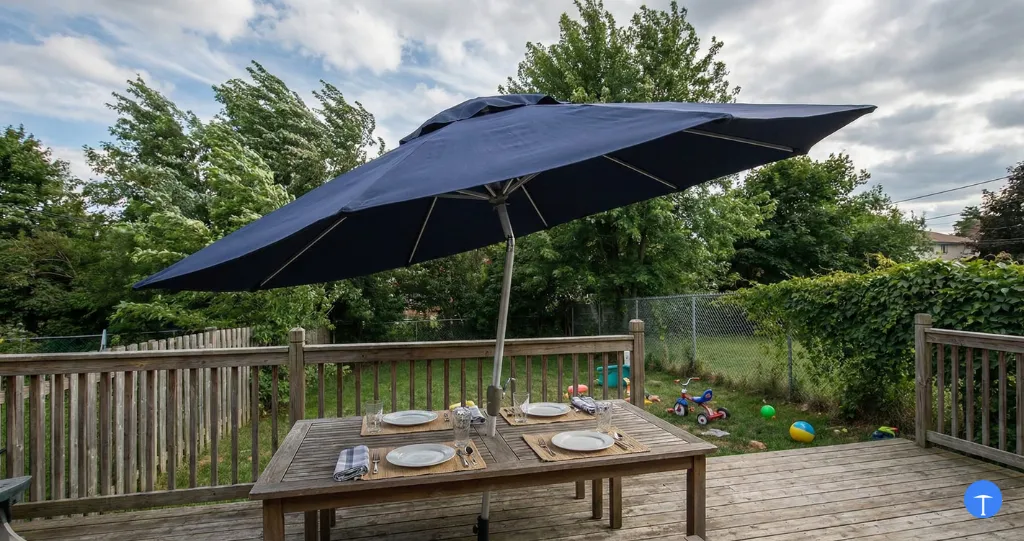
Most patio umbrellas can withstand 15 to 25 MPH of sustained wind when properly installed, though this range varies dramatically by umbrella type and setup quality. Budget models often fail at the lower end of that range, while commercial grade umbrellas can handle 35 MPH or more. Understanding these numbers requires looking past marketing language to the actual specifications and testing conditions behind them.
Standard residential patio umbrellas handle sustained winds between 15 and 25 MPH. That covers a moderate breeze up to the point where tree branches start swaying noticeably.
The catch is that “designed for” and “will survive” aren’t the same thing. Your umbrella’s actual wind tolerance depends on factors the manufacturer can’t control: base weight, mounting quality, surface conditions, and whether you’re dealing with steady wind or sudden gusts.
When manufacturers cite a wind rating, they almost always mean sustained wind speed. A “25 MPH rated” umbrella is supposed to handle continuous wind at that speed, not a 25 MPH gust hitting an otherwise calm umbrella.
This distinction matters because gusts typically hit 20 to 40 percent harder than sustained wind speeds. On a day with 20 MPH sustained winds, gusts might reach 25 to 28 MPH. If your umbrella is rated for 25 MPH sustained, those gusts are already pushing its structural limits.
Real world wind rarely blows at a constant speed. It pulses, swirls, and changes direction. That’s why an umbrella performing fine in steady 20 MPH wind might suddenly flip or bend when the same average wind includes strong gusts. Gust resistance is rarely tested or specified, leaving you to guess how much buffer exists above the stated rating.
There’s a critical difference between what an umbrella can withstand and what you should actually use it in. Manufacturers typically rate for structural limits, the point where damage becomes likely. But your safe operating range is lower.
A 25 MPH rated umbrella might survive that wind speed without breaking, but operating at that limit means constant stress on frame joints and a base working hard to stay put. The safe operating range for that umbrella is probably 15 to 18 MPH, where everything functions without strain. This gap explains why umbrellas sometimes fail below their stated ratings.
Most umbrella wind ratings come from controlled testing or engineering calculations, not real outdoor conditions. In a lab, wind flows uniformly from a single direction with the umbrella on an immovable mount. Your patio has turbulence from buildings, wind from changing angles, and a base that can shift.
Some manufacturers don’t test at all. They base ratings on material strength calculations or match competitor claims. Without standardized testing protocols in the industry, “wind rated to 25 MPH” means different things from different brands. If a manufacturer can’t explain how they determined their rating, treat that number skeptically.
| Umbrella Type | Typical Rating | Real World Range | Notes |
|---|---|---|---|
| Budget market umbrella | 15 MPH | 10-15 MPH | Lightweight frames bend easily |
| Mid range market umbrella | 20-25 MPH | 15-20 MPH | Depends heavily on base weight |
| Premium market umbrella | 25-30 MPH | 20-25 MPH | Requires proper installation |
| Standard cantilever | 20-25 MPH | 15-20 MPH | Offset design adds frame stress |
| Heavy duty cantilever | 30-35 MPH | 25-30 MPH | Needs anchored base system |
| Commercial grade | 35-50 MPH | 30-40 MPH | Professional installation typical |
Traditional center pole market umbrellas offer the most predictable wind performance. The centered pole distributes stress evenly, and gravity works in your favor by pulling straight down through the support structure.
Budget market umbrellas under $100 use thinner aluminum or steel frames that bend permanently in winds as low as 15 MPH. The parts of a patio umbrella most vulnerable to wind are the rib joints and hub connection, where thin metal fatigues quickly.
Mid range and premium market umbrellas use thicker gauge aluminum or fiberglass ribs that flex without permanent deformation. Fiberglass handles gusts particularly well because it absorbs energy and returns to shape rather than bending.
Cantilever umbrellas face unique challenges because the canopy sits offset from the support pole. This creates leverage that amplifies wind force on the frame and base. A 20 MPH wind hitting a cantilever generates more frame stress than the same wind hitting a center pole umbrella of equal size.
The offset design also makes cantilevers susceptible to twisting when wind shifts direction, stressing the rotation mechanism. If you’re troubleshooting cantilever problems, wind damage to the swivel joint is among the most common issues.
Heavy duty cantilevers compensate with reinforced frames and substantial base requirements. Some need 200 or more pounds of weight, while others require in ground installation to achieve their rated tolerance.
Commercial patio umbrellas are engineered for seasons of daily use in exposed restaurant patios and resort settings. Their 35 to 50 MPH ratings reflect heavier frames, thicker poles, and reinforced hardware throughout.
The gap between commercial and residential isn’t just materials. Commercial umbrellas are designed for professional installation with in ground mounting sleeves or bolted base plates. A commercial umbrella on a freestanding weighted base won’t perform to its full rating because the base might slide or tip before the umbrella reaches its structural limits.
Your umbrella’s real wind capacity depends on your specific setup:
Base weight and type is the most critical factor. A 50 pound base won’t stabilize like a 100 pound base regardless of frame quality. For guidance, see our recommendations for umbrella bases designed for windy areas.
Surface conditions matter more than expected. Umbrellas on smooth concrete are prone to base sliding. Slight slopes amplify tipping risk.
Canopy condition degrades over time. UV damaged fabric loses tension and catches wind differently. Loose fabric flaps violently, creating stress spikes.
Vented canopy design reduces wind load by letting air pass through. Umbrellas with wind vents often handle 5 to 10 MPH more than non vented equivalents. For details, see our vented vs non vented umbrella comparison.
Frame age and wear accumulates invisibly. Ribs weakened by repeated flexing fail at lower wind speeds than new units.
Mounting method determines whether you approach design limits. In ground poles dramatically outperform freestanding bases.
Understanding what happens when wind exceeds capacity helps you recognize warning signs:
Frame bending typically starts at rib joints where stress concentrates. You might notice ribs that no longer sit symmetrically or don’t close flush. Once bent, those weakened points fail more easily next time.
Canopy tearing occurs at stress points: stitched seams, corners where fabric attaches to ribs, and around the pole opening. Small tears expand quickly in gusty conditions.
Hub and pole connection failure happens when the central mechanism cracks or the pole attachment strips. These failures often end the umbrella’s useful life.
Base failure vs structural failure is worth noting. Often the base tips before the umbrella sustains damage. This is actually better since you can add weight. When the umbrella fails first, you’re shopping for a replacement.
Cumulative damage from repeated near limit exposure weakens components gradually. An umbrella that survives several close calls might fail on the next one as accumulated stress exceeds remaining strength.
| Spec Term | What It Means | What to Watch For |
|---|---|---|
| Wind rated | Has a specific MPH claim | Ask how rating was determined |
| Wind tested | Underwent some form of testing | May be limited test conditions |
| Wind resistant | General marketing language | No specific performance claim |
| Withstands winds up to X MPH | Upper limit claim | Usually means sustained wind only |
| Heavy duty | Stronger than standard line | Relative term, no industry standard |
| Commercial grade | Built for business use | Check if rating requires pro install |
Look for specific numbers rather than descriptive terms. “Heavy duty” and “wind resistant” are subjective. A specific MPH rating gives you something to compare, even discounted 20 percent for real conditions.
Watch for ratings that seem implausible for the price. A $150 umbrella claiming 40 MPH tolerance is probably using optimistic calculations rather than testing data.
Expect real world performance to fall 15 to 25 percent below stated ratings. A 25 MPH rated umbrella performing well at 20 MPH in variable wind is meeting reasonable expectations. Installation quality explains most of the gap.
Environmental factors also play a role. Wind channeled between buildings accelerates beyond open area speeds. Nearby structures create turbulence that hits from unexpected angles. These conditions differ significantly from controlled testing.
For a detailed look at construction elements that improve wind handling, see our guide on what makes an umbrella windproof.
Destruction typically happens at 1.5 to 2 times the rated wind tolerance. A 20 MPH rated umbrella might bend or break around 30 to 40 MPH. However, damage can occur at lower speeds if the base fails first, sending the umbrella tumbling across hard surfaces.
Yes, when properly installed. Commercial umbrellas use thicker poles, heavier gauge ribs, and reinforced connection points that genuinely handle higher wind loads. But their ratings assume professional mounting methods that most residential setups don’t provide.
Installation requirements and base specifications change the system rating. The same umbrella might be rated for 25 MPH with an 80 pound base but 30 MPH with in ground mounting. Some retailers also apply different testing assumptions than manufacturers do.
No residential or commercial patio umbrella should remain open during storms. Storm winds are unpredictable, commonly exceeding 40 to 60 MPH with sudden gusts, rapid direction changes, and flying debris. No patio umbrella is designed for storm conditions.
Typically no. Published ratings almost always reference sustained wind speeds. Since gusts commonly run 20 to 40 percent higher than sustained speeds, close your umbrella well before sustained winds approach its rated limit.
Understanding your umbrella’s wind tolerance helps you make informed decisions about when to close your umbrella rather than testing its limits. The goal is years of reliable use, not proving what the product can survive.
Invest in appropriate base weight for your umbrella size and typical wind exposure. Use proper methods to prevent your umbrella from blowing over. Treat manufacturer wind ratings as guidelines for comparison rather than guarantees of performance.
The most wind resistant umbrella available won’t perform to its rating if the base tips or slides first. Match your entire system to your actual conditions, and you’ll avoid most wind related problems while getting full value from your investment.